Reaction Scheme Involving Lactone Reduction and Subsequent Reactions
With reference to the scheme given, which of the given statment(s) about and is (are) correct ?
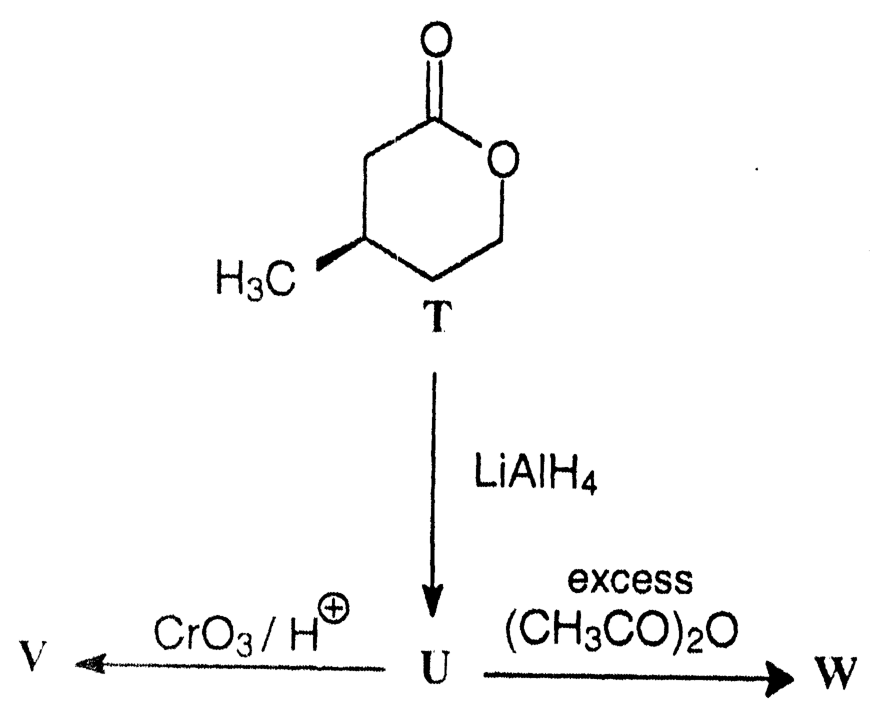
Options
ACorrect
is soluble in hot aqueous
B
is optically active
CCorrect
Molecular formula of is
DCorrect
gives effervescence on treatment with aqueous
Step-by-Step Solution
To determine the correct statements about compounds and , we analyze each step in the given reaction sequence:
1. Analysis of Compound and Option A
- Compound is a -lactone (a cyclic ester), specifically 4-methyltetrahydro-2H-pyran-2-one with molecular formula .
- When heated with aqueous , lactones undergo base-catalyzed hydrolysis (saponification) to form the sodium salt of a hydroxy carboxylic acid:
- The ionic sodium hydroxycarboxylate salt is highly polar and water-soluble. Thus, is soluble in hot aqueous .
- Option A is correct.
2. Reduction of to and Option B
- Reduction of the lactone using lithium aluminium hydride () cleaves the cyclic ester linkage to yield a primary diol :
- Compound is 3-methylpentane-1,5-diol.
- The central carbon () is attached to a hydrogen atom, a methyl group (), and two identical chain segments.
- Due to the presence of two identical substituents on , the molecule possesses a plane of symmetry, making it achiral and optically inactive.
- Option B is incorrect.
3. Formation of and Option C
- Treatment of diol with excess acetic anhydride, , acetylates both hydroxyl groups to give the diacetate ester :
- Counting the atoms in :
- Carbons:
- Hydrogens:
- Oxygens:
- Thus, the molecular formula of is .
- Option C is correct.
4. Oxidation of to and Option D
- Oxidation of the primary diol with Jones reagent () oxidizes both primary alcohol () groups into carboxylic acid () groups:
- Compound is a dicarboxylic acid (3-methylpentanedioic acid).
- Carboxylic acids react with aqueous sodium bicarbonate () to liberate carbon dioxide () gas, resulting in effervescence:
- Option D is correct.
Conclusion
The correct options are A, C, and D.