Determine Correct Stereochemical Relationships Among Given Molecules
Which of the given statement(s) about and with respect to is (are) correct ?
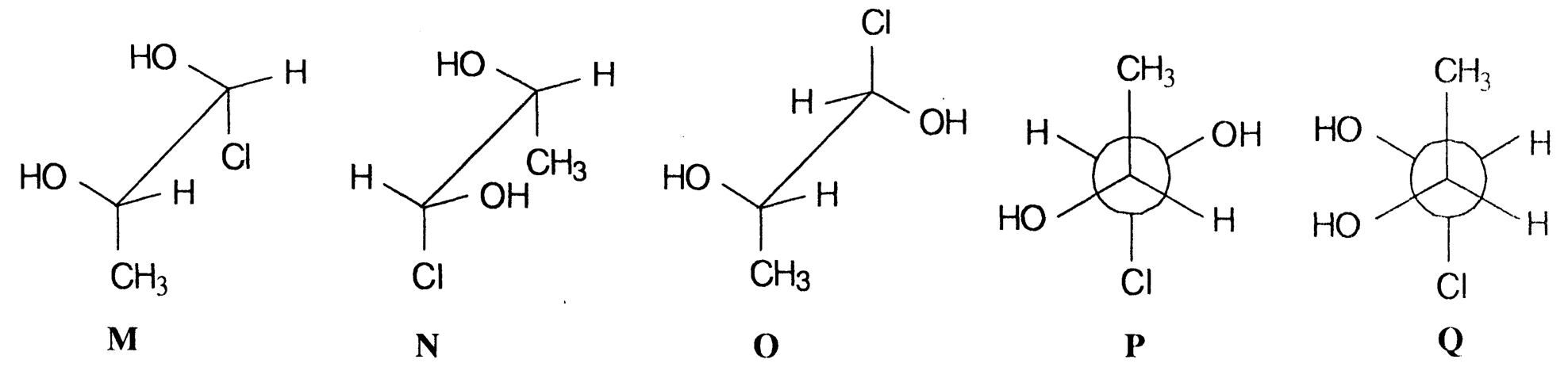
Options
and are non-mirror image stereoisomers
and are identical
and are enantiomers
and are identical
Topics & Concepts
Step-by-Step Solution
To determine the stereochemical relationships among the given molecules and , we assign absolute configurations to the two chiral centers in each structure using the Cahn-Ingold-Prelog (CIP) priority rules.
1. Priority Rules for the Chiral Centers
The given compound is 1-chloropropane-1,2-diol with two chiral carbons, denoted as and :
-
At (carbon attached to and ):
-
At (carbon attached to and ):
2. Absolute Configuration Analysis
Molecule M:
- Front carbon (): is at the bottom, is top-left, is top-right. Viewing along the bond gives the configuration .
- Back carbon (): is top-left, is top-right, is bottom-right. Determining priority path yields the configuration .
Molecule N:
-
Front carbon (): is at the bottom, is on the left, is on the right, which gives the configuration .
-
Back carbon (): is top-left, is top-right, is on the right, which gives the configuration .
-
Relationship ( vs ): and differ at one chiral center. They are non-superimposable, non-mirror image stereoisomers, i.e., diastereomers (non-mirror image stereoisomers).
Statement (A) is CORRECT.
Molecule O:
-
Rotating the back carbon () of molecule by counter-clockwise around the single bond yields molecule .
-
Since bond rotation does not alter absolute configuration:
-
Relationship ( vs ): Both molecules have the configuration and represent conformers of the same compound. Thus, and are identical.
Statement (B) is CORRECT.
Molecule P:
-
Front carbon (): is at 12 o'clock, is at 8 o'clock, is at 4 o'clock, yielding configuration .
-
Back carbon (): is at 2 o'clock, is at 6 o'clock, is at 10 o'clock, yielding configuration .
-
Relationship ( vs ): and have all chiral centers inverted. They are non-superimposable mirror images of each other, i.e., enantiomers.
Statement (C) is CORRECT.
Molecule Q:
-
Front carbon (): Configuration is (identical to ).
-
Back carbon (): is at 2 o'clock, is at 6 o'clock, is at 10 o'clock, yielding configuration .
-
Relationship ( vs ): and are diastereomers, not identical.
Statement (D) is INCORRECT.
Conclusion
The correct options are A, B, and C.