Reaction of Anisole with Hydrogen Bromide
In the reaction
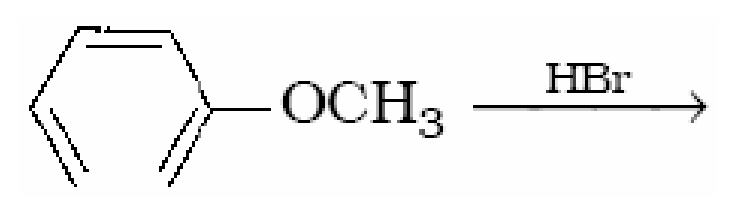
the products are
Options
A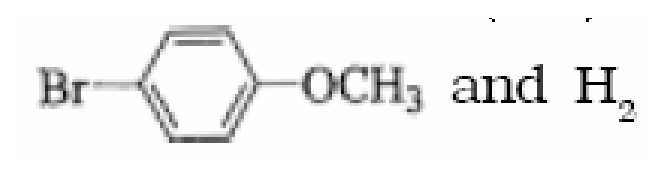
B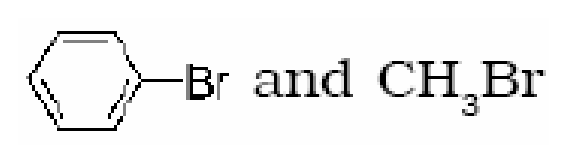
C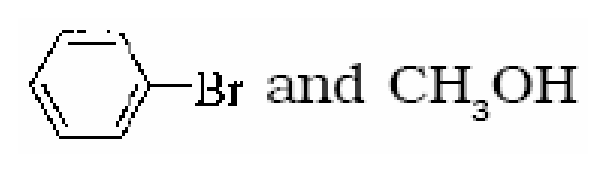
D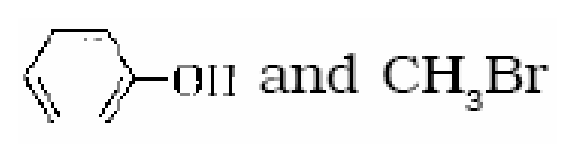 Correct
Topics & Concepts
Step-by-Step Solution
To determine the products of the reaction of anisole () with hydrogen bromide (), we analyze the reaction mechanism step by step:
-
Protonation of the Ether:
The lone pair of electrons on the oxygen atom of anisole acts as a Lewis base and accepts a proton from to form an oxonium ion intermediate:
-
Nucleophilic Attack by Bromide Ion ():
In the protonated ether, there are two potential carbon atoms for nucleophilic attack by the bromide ion:- The phenyl carbon (): The bond between the phenyl carbon and the oxygen atom has partial double-bond character due to resonance with the benzene ring. It is stronger and shorter than a typical single bond. Moreover, displacement at an -hybridized aromatic carbon is energetically unfavorable and hindered by electronic repulsion from the -cloud of the ring.
- The methyl carbon (): The bond between the methyl carbon and the oxygen atom is a normal single bond at an unhindered, -hybridized carbon.
Therefore, the nucleophile selectively attacks the methyl carbon via an pathway:
Thus, the reaction produces phenol () and bromomethane ().
Therefore, the correct option is D.