Ratio of Magnifications for Mirror Lens System in Different Media
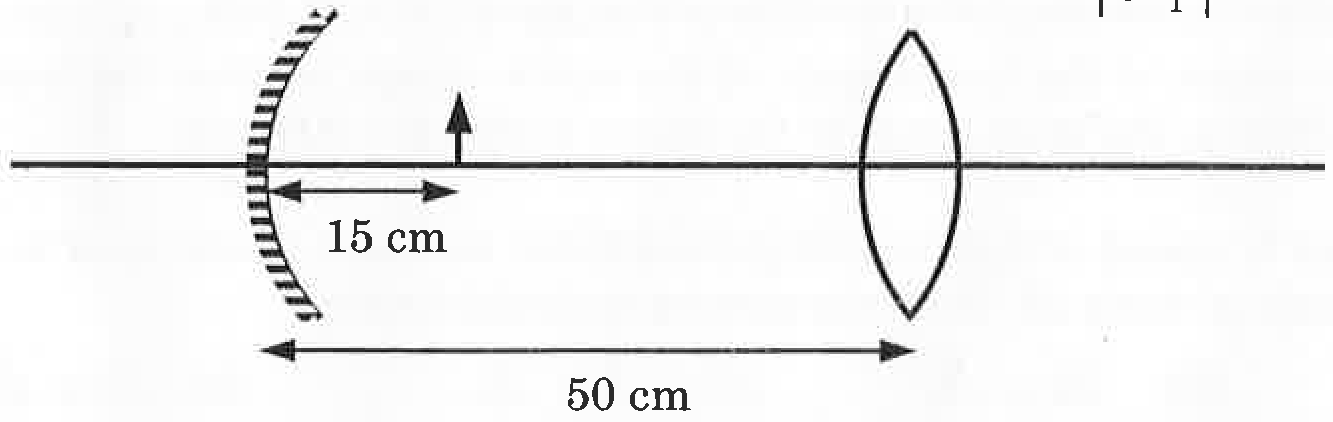
Consider a combination of a concave mirror and a convex lens (refractive index = 1.5) with focal lengths of 10 cm each, placed 50 cm apart in air (refractive index = 1). An object is positioned 15 cm in front of the mirror. The erect image created by this system exhibits magnification M1. Upon placing the entire setup in a medium having refractive index 7/6, the magnification changes to M2. Calculate the value of M1M2.
To find the magnitude of the ratio of the magnifications M1M2, we analyze the image formation by the mirror-lens combination in both cases step-by-step.
1. Image Formation by the Concave Mirror
The focal length of a spherical mirror depends only on its radius of curvature, so it remains unchanged when immersed in a medium:
fm=−10 cm
The object is placed in front of the concave mirror at a distance um=−15 cm.
Using the mirror formula:
vm1+um1=fm1
Substitute the values:
vm1+−151=−101vm1=−101+151=−301⟹vm=−30 cm
The linear magnification produced by the mirror is:
mm=−umvm=−−15−30=−2
Since the distance between the mirror and the lens is d=50 cm, the image formed by the mirror acts as a real object for the convex lens at a distance:
ul=−(50−30)=−20 cm
2. Magnification in Air (M1)
In air (μair=1), the focal length of the convex lens is fl1=+10 cm.
Using the lens formula:
vl11−ul1=fl11
vl11−−201=101vl11=101−201=201⟹vl1=+20 cm
The magnification of the lens in air is:
ml1=ulvl1=−2020=−1
Thus, the total magnification M1 of the system in air is:
M1=mm×ml1=(−2)×(−1)=2
3. Magnification in the Medium (M2)
When the entire setup is placed in a medium of refractive index μm=67, the focal length of the lens changes.
From Lens Maker's Formula:
fl11=(μairμl−1)(R11−R21)101=(1.5−1)(R11−R21)=0.5(R11−R21)⟹(R11−R21)=51 cm−1
For the medium of refractive index μm=67:
fl21=(μmμl−1)(R11−R21)fl21=(7/61.5−1)(51)=(79−1)51=352 cm−1fl2=235 cm
Now, using the lens formula for the lens in the medium:
vl21−−201=352vl21=352−201=1408−7=1401⟹vl2=+140 cm
The magnification of the lens in the medium is:
ml2=ulvl2=−20140=−7
Thus, the total magnification M2 of the system in the medium is:
M2=mm×ml2=(−2)×(−7)=14
4. Ratio of Magnifications
The ratio of the magnitude of magnifications is:
M1M2=214=7