Find Integer Parameter in Young's Double Slit Water Immersion Maxima
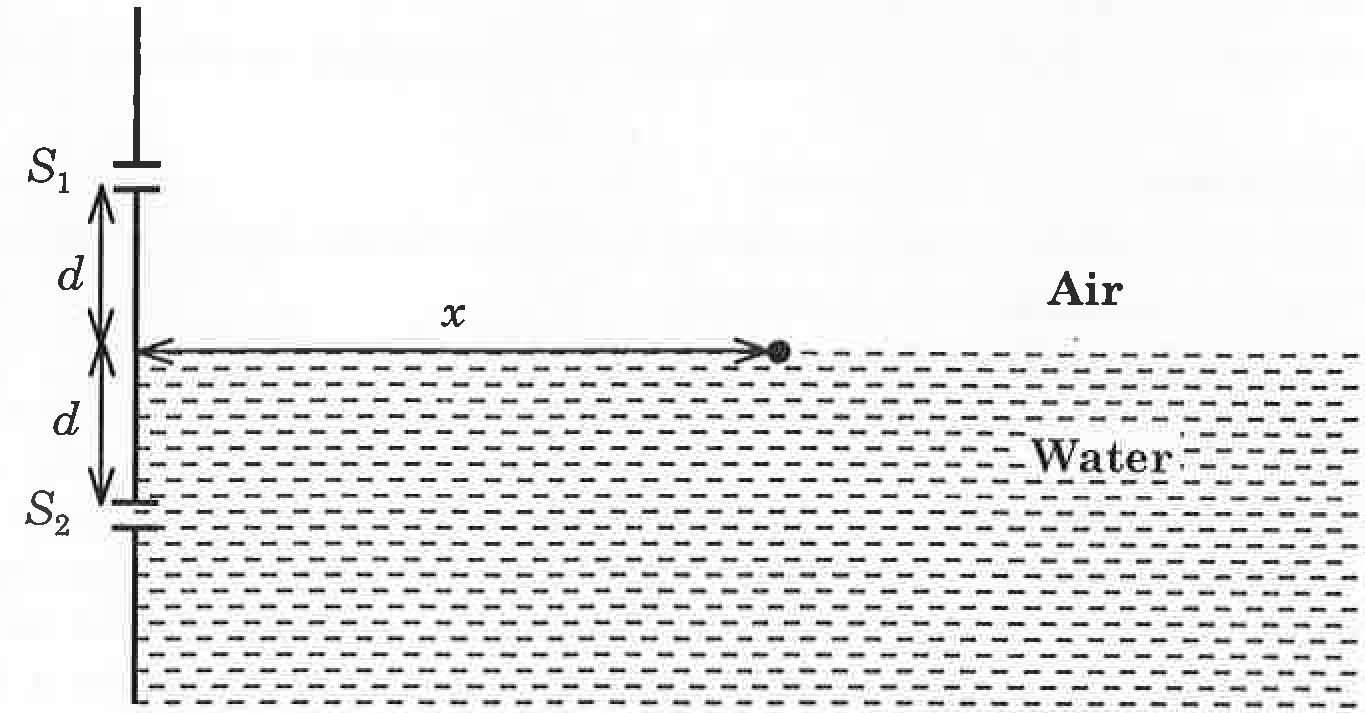
A Young's double slit interference setup with slits and is submerged in water (refractive index = 4/3), as depicted in the figure. Maxima positions on the water surface follow , where represents the light wavelength in air (refractive index = 1), denotes slit separation, and is an integer. Determine the value of .
Topics & Concepts
Step-by-Step Solution
To find the value of , we analyze the optical path difference between the light rays arriving at a point on the water surface from the two slits and .
1. Geometric Setup: Let the plane containing the two slits and lie along the vertical -axis, with the origin located at the midpoint between the slits on the water surface:
- Slit is located at in air (refractive index ).
- Slit is located at in water (refractive index ).
- A point on the water surface is at a distance from the origin, so its coordinates are .
2. Geometric Path Lengths: The geometric distance from to is:
The geometric distance from to is:
3. Optical Path Lengths:
-
The ray from travels entirely through air to reach point :
-
The ray from travels entirely through water to reach point :
4. Optical Path Difference and Maxima Condition: The optical path difference between the two rays at point is given by:
For constructive interference (maxima), the optical path difference must be an integer multiple of the wavelength of light in air:
Substituting :
Squaring both sides gives:
5. Comparing with the Given Relation: The problem gives the positions of maxima as:
Comparing the coefficients of :