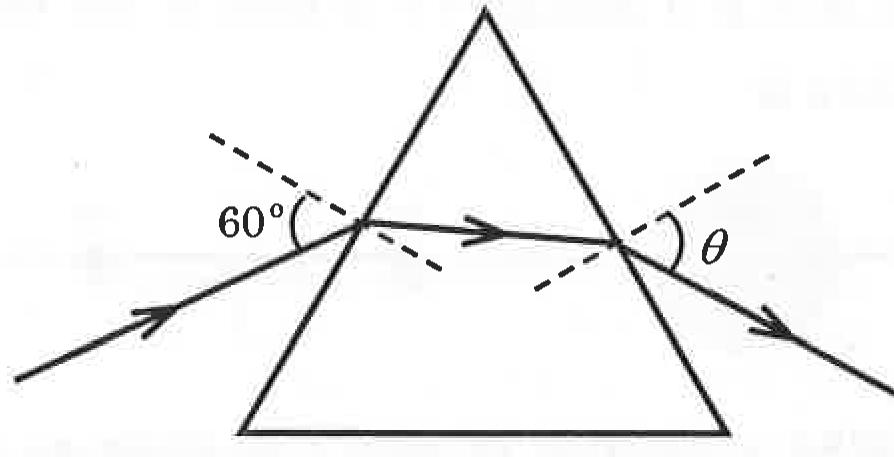
An equilateral prism has a refracting angle A = 60 ∘ A = 60^\circ A = 6 0 ∘
The angle of incidence at the first face is given as i = 60 ∘ i = 60^\circ i = 6 0 ∘
Applying Snell's law at the first surface of refraction:
sin i = n sin r 1 \sin i = n \sin r_1 sin i = n sin r 1
Since the angle of incidence i i i n n n 0 = sin r 1 + n cos r 1 d r 1 d n 0 = \sin r_1 + n \cos r_1 \frac{dr_1}{dn} 0 = sin r 1 + n cos r 1 d n d r 1 d r 1 d n = − tan r 1 n \frac{dr_1}{dn} = -\frac{\tan r_1}{n} d n d r 1 = − n t a n r 1
For a prism of angle A A A r 1 + r 2 = A r_1 + r_2 = A r 1 + r 2 = A
Differentiating with respect to n n n d r 1 d n + d r 2 d n = 0 ⟹ d r 2 d n = − d r 1 d n = tan r 1 n \frac{dr_1}{dn} + \frac{dr_2}{dn} = 0 \implies \frac{dr_2}{dn} = -\frac{dr_1}{dn} = \frac{\tan r_1}{n} d n d r 1 + d n d r 2 = 0 ⟹ d n d r 2 = − d n d r 1 = n t a n r 1
Applying Snell's law at the second surface of refraction:
sin θ = n sin r 2 \sin \theta = n \sin r_2 sin θ = n sin r 2
Differentiating with respect to n n n cos θ d θ d n = sin r 2 + n cos r 2 d r 2 d n \cos \theta \frac{d\theta}{dn} = \sin r_2 + n \cos r_2 \frac{dr_2}{dn} cos θ d n d θ = sin r 2 + n cos r 2 d n d r 2
Substitute d r 2 d n = tan r 1 n \frac{dr_2}{dn} = \frac{\tan r_1}{n} d n d r 2 = n t a n r 1 cos θ d θ d n = sin r 2 + n cos r 2 ( tan r 1 n ) \cos \theta \frac{d\theta}{dn} = \sin r_2 + n \cos r_2 \left(\frac{\tan r_1}{n}\right) cos θ d n d θ = sin r 2 + n cos r 2 ( n t a n r 1 ) cos θ d θ d n = sin r 2 + cos r 2 tan r 1 \cos \theta \frac{d\theta}{dn} = \sin r_2 + \cos r_2 \tan r_1 cos θ d n d θ = sin r 2 + cos r 2 tan r 1
Now, evaluate the angles for n = 3 n = \sqrt{3} n = 3
From sin ( 60 ∘ ) = 3 sin r 1 \sin(60^\circ) = \sqrt{3} \sin r_1 sin ( 6 0 ∘ ) = 3 sin r 1 3 2 = 3 sin r 1 ⟹ sin r 1 = 1 2 ⟹ r 1 = 30 ∘ \frac{\sqrt{3}}{2} = \sqrt{3} \sin r_1 \implies \sin r_1 = \frac{1}{2} \implies r_1 = 30^\circ 2 3 = 3 sin r 1 ⟹ sin r 1 = 2 1 ⟹ r 1 = 3 0 ∘
The angle r 2 r_2 r 2 r 2 = A − r 1 = 60 ∘ − 30 ∘ = 30 ∘ r_2 = A - r_1 = 60^\circ - 30^\circ = 30^\circ r 2 = A − r 1 = 6 0 ∘ − 3 0 ∘ = 3 0 ∘
The emergence angle θ \theta θ 60 ∘ 60^\circ 6 0 ∘
Substitute r 1 = 30 ∘ r_1 = 30^\circ r 1 = 3 0 ∘ r 2 = 30 ∘ r_2 = 30^\circ r 2 = 3 0 ∘ θ = 60 ∘ \theta = 60^\circ θ = 6 0 ∘ cos 60 ∘ ( d θ d n ) = sin 30 ∘ + cos 30 ∘ tan 30 ∘ \cos 60^\circ \left(\frac{d\theta}{dn}\right) = \sin 30^\circ + \cos 30^\circ \tan 30^\circ cos 6 0 ∘ ( d n d θ ) = sin 3 0 ∘ + cos 3 0 ∘ tan 3 0 ∘ 1 2 m = 1 2 + ( 3 2 ) ( 1 3 ) \frac{1}{2} m = \frac{1}{2} + \left(\frac{\sqrt{3}}{2}\right)\left(\frac{1}{\sqrt{3}}\right) 2 1 m = 2 1 + ( 2 3 ) ( 3 1 ) 1 2 m = 1 2 + 1 2 = 1 \frac{1}{2} m = \frac{1}{2} + \frac{1}{2} = 1 2 1 m = 2 1 + 2 1 = 1 m = 2 m = 2 m = 2