Qualitative Shape of Image Formed by Concave Mirror for Triangular Wire
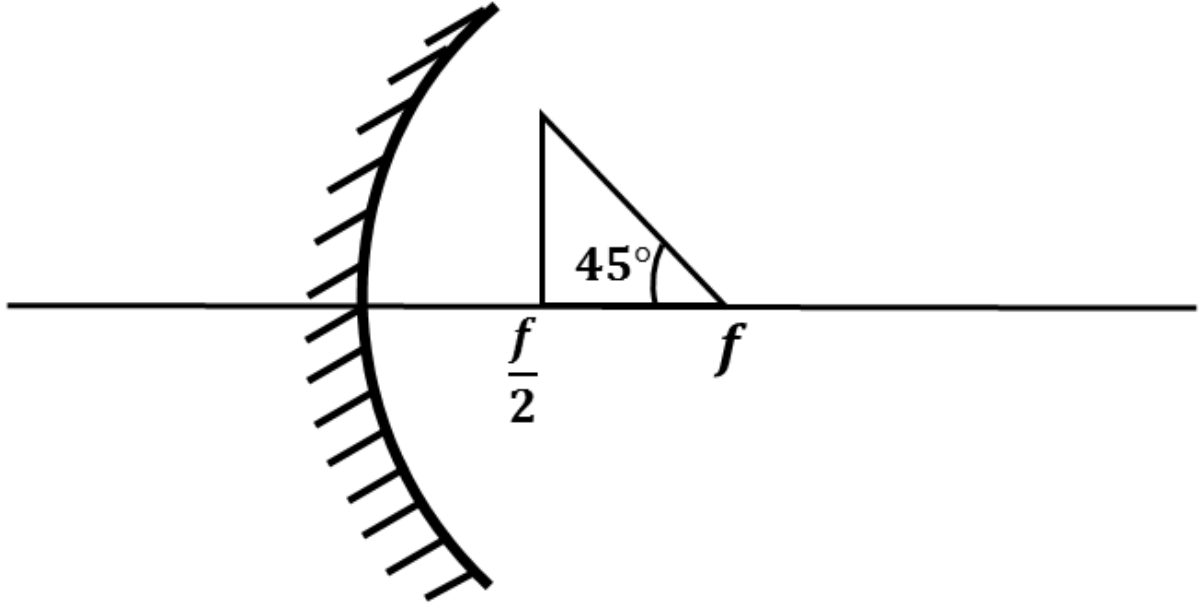
A wire is formed into a right-angled triangle and placed in front of a concave mirror with focal length , as illustrated in the figure. Which option(s) qualitatively depict(s) the shape of the resulting image of the bent wire? (The diagrams are not drawn to scale.)
Options
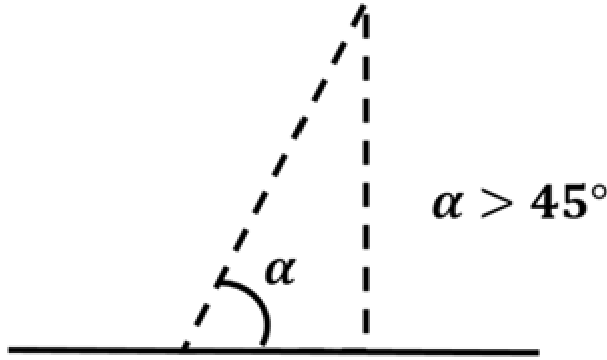
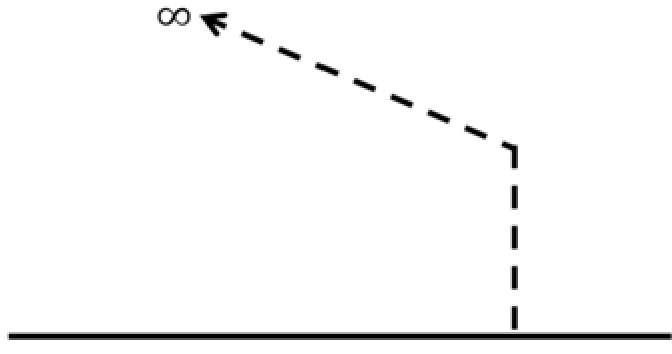
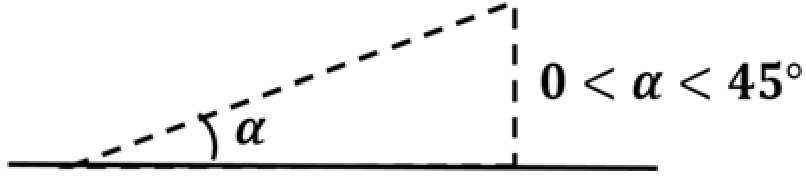
Step-by-Step Solution
To determine the qualitative shape of the image formed by the concave mirror, we analyze the mapping of each side of the triangular wire frame using the mirror formula and transverse magnification formula.
1. Coordinate System Setup
Let the pole of the concave mirror be at the origin on the principal axis. Since the mirror is concave with a focal length , its focal point is located at .
The object is a right-angled triangular wire located in front of the mirror ():
- Vertical leg: Located at , extending from to .
- Horizontal leg: Lies along the principal axis from to .
- Hypotenuse: Connects the points and .
The equation describing the hypotenuse of the triangle in object space is:
2. Mirror Formula and Magnification
For a point object located at distance (where ), the image position is given by the mirror formula:
Substituting :
The transverse magnification is given by:
3. Image of Each Segment
A. Image of the Vertical Leg (, )
-
Position: The image of the vertical leg is formed behind the mirror (virtual image) at .
-
Height: Since the height of the vertical leg is , the height of its image is:
Thus, the vertical leg maps to a vertical line segment at extending from to .
B. Image of the Horizontal Leg (, )
-
At , .
-
As , .
Thus, the horizontal leg along the principal axis maps to a ray lying on the principal axis extending from to .
C. Image of the Hypotenuse (, )
The height of any point on the image of the hypotenuse is given by:
Substituting and :
Remarkably, is constant and independent of for all points along the hypotenuse!
- At , and .
- As , and .
Thus, the hypotenuse maps to a horizontal straight line parallel to the principal axis at a height , extending from to .
Conclusion
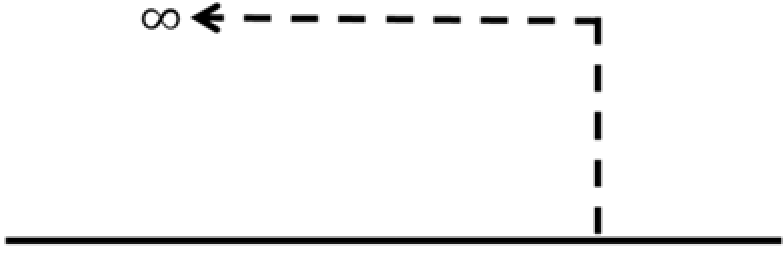
Combining the images of all three sides:
- A vertical segment at of height .
- A horizontal segment on the principal axis from to .
- A horizontal line parallel to the principal axis at height extending from to .
This matches the qualitative shape depicted in Option (D).