Electric Flux and Field due to Long Charged Wire Piercing Spherical Shell
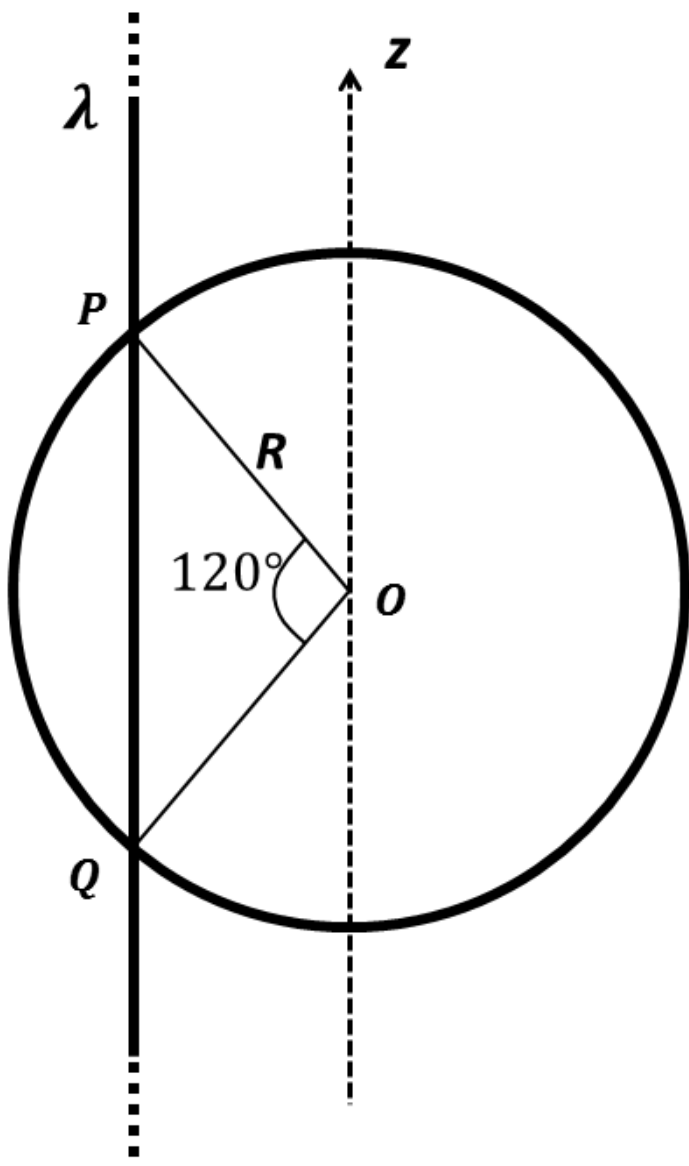
An infinitely long thin non-conducting line charge oriented parallel to the -axis has a uniform charge density . It pierces through a thin non-conducting spherical shell of radius such that the intercepted arc subtends an angle of at the shell's center , as illustrated in the figure. Let be the permittivity of free space. Which of the following assertions is (are) correct?
Options
The total electric flux passing through the spherical shell equals
The -component of the electric field vector is zero across all points on the surface of the shell
The total electric flux passing through the spherical shell equals
The electric field is perpendicular to the spherical shell surface at every point on it
Topics & Concepts
Step-by-Step Solution
To determine the correct statements, we analyze each option using the principles of electrostatics and Gauss's Law:
-
Total Electric Flux Through the Spherical Shell: According to Gauss's Law, the total electric flux passing through a closed surface is given by: where is the total charge enclosed within the spherical shell.
The length of the line charge segment enclosed by the sphere can be calculated using the chord length formula for a circle of radius : Given that the intercepted arc subtends an angle at the shell's center :
The enclosed charge is therefore:
Substituting into Gauss's Law gives:
Thus, Option (A) is correct, and Option (C) is incorrect.
-
-component of the Electric Field: The line charge is infinitely long, straight, uniform, and oriented parallel to the -axis. The electric field at any point due to an infinitely long line charge is directed purely radially outward (or inward) in the plane perpendicular to the line charge (i.e., in the -plane).
Consequently, the electric field has no component along the length of the line charge: This holds true for all points in space, including every point on the surface of the spherical shell.
Thus, Option (B) is correct.
-
Direction of the Electric Field Relative to the Shell Surface: The normal to the surface of a sphere at any point lies along the radius vector extending from its center . For the electric field to be normal to the surface of the shell at all points, the field vectors must be directed radially outward from .
However, the electric field due to the line charge is directed radially outward from the line charge itself, not from the sphere's center . Therefore, the electric field vector is not perpendicular to the spherical shell's surface at all points.
Thus, Option (D) is incorrect.
Correct Answer: (A) and (B)