Products of Aniline Multistep Reaction Involving Bromination and Diazotization
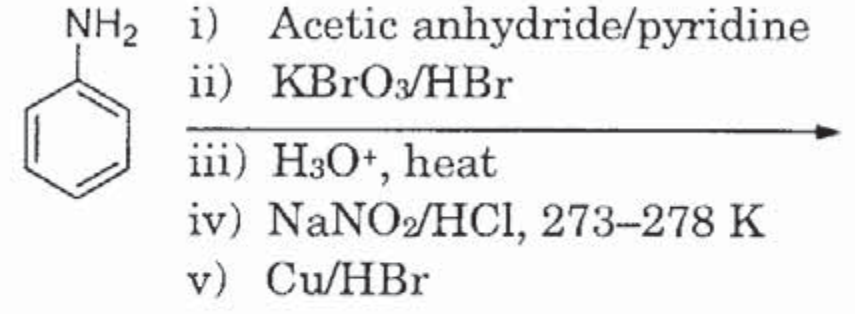
Determine the main product(s) resulting from the following sequence of chemical reactions starting with aniline:
Options
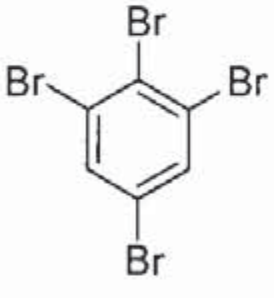
Topics & Concepts
Step-by-Step Solution
To determine the major product of the given multistep reaction, let us analyze each step sequentially:
Step 1: Acetylation
Aniline () reacts with acetic anhydride () in the presence of pyridine.
- Mechanism: The lone pair on the nitrogen atom of aniline attacks the carbonyl carbon of acetic anhydride, undergoing a nucleophilic acyl substitution to yield acetanilide ().
- Purpose: The bulky acetamido group () moderates the activating effect of the group (due to resonance delocalization of nitrogen's lone pair into the carbonyl group) and prevents polybromination while offering steric hindrance to the ortho-positions.
Step 2: Bromination
Potassium bromate () reacts with hydrobromic acid () to generate bromine () in situ:
- Reaction: Acetanilide undergoes electrophilic aromatic substitution with . Since the group is strongly para-directing and sterically bulky, bromination occurs predominantly at the para-position to form -bromoacetanilide (p-bromoacetanilide).
Step 3: Acid Hydrolysis
Heating -bromoacetanilide with aqueous acid () hydrolyzes the amide linkage, regenerating the primary amino group to yield -bromoaniline (p-bromoaniline).
Step 4: Diazotization
-bromoaniline is treated with nitrous acid () at ().
- Reaction: The primary aromatic amine is converted into a diazonium salt, giving -bromobenzenediazonium chloride.
Step 5: Gattermann Reaction
Reaction of -bromobenzenediazonium chloride with copper powder and hydrobromic acid () replaces the diazonium group () with a bromine atom ().
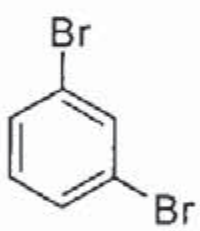
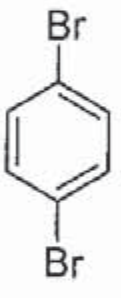
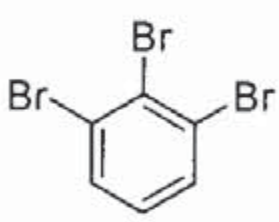
Thus, the final product of the reaction sequence is 1,4-dibromobenzene, corresponding to structure (B).
Correct Answer: B