Pressure Difference in Accelerated Cylindrical Tube with Water
Consider a cylindrical vessel filled with water, positioned as illustrated in the figure. It moves downward with a uniform acceleration along a fixed inclined plane angled at . The pressures at points 1 and 2 located at the bottom of the tube are and , respectively. Let , where denotes the fluid density, is the inner diameter of the tube, and is the acceleration due to gravity. Which of the following option(s) is(are) correct?
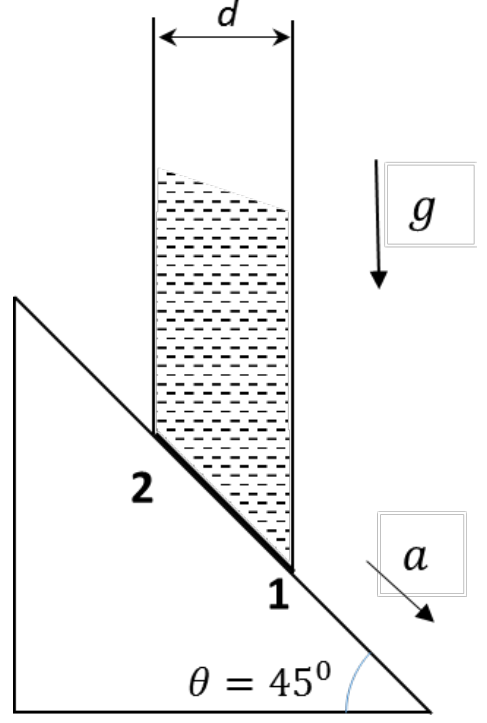
Options
when
when
when
when
Topics & Concepts
Step-by-Step Solution
To determine the pressure difference between points and located at the bottom of the cylindrical vessel, we analyze the fluid dynamics in the non-inertial frame of reference attached to the accelerating vessel.
1. Frame of Reference and Effective Acceleration
The vessel moves down the inclined plane (angled at ) with a uniform acceleration . Defining a Cartesian coordinate system with pointing horizontally to the right and pointing vertically upwards:
-
The acceleration vector of the vessel is given by:
-
The acceleration due to gravity is:
In the non-inertial reference frame of the vessel, the effective acceleration due to gravity acting on the fluid is:
2. Pressure Gradient and Difference
The pressure gradient inside the accelerated fluid is governed by:
Let and be the position vectors of points and , respectively. Since the base of the tube lies along the inclined plane at an angle :
- The horizontal separation between points and is .
- Point is lower than point along the vertical by .
Thus, the displacement vector from point to point is:
The pressure difference between points and is:
3. Evaluating
The dimensionless parameter is defined as:
Now we test the given conditions:
-
For : Therefore, (A) is correct and (B) is incorrect.
-
For : Therefore, (C) is correct and (D) is incorrect.
Conclusion
The correct options are A and C.