Motional EMF on Semicircular Rod Near Current Wire Connected to RC Circuit
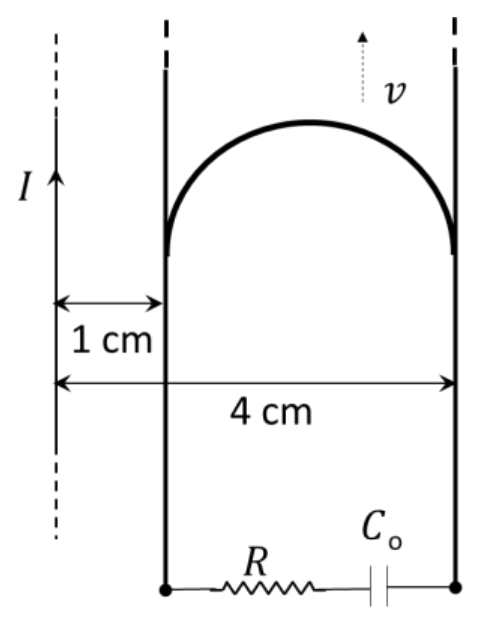
A long straight wire carries a current . A semi-circular conducting rod rests on two parallel conducting rails of negligible resistance, lying in the same horizontal plane as the wire. The two ends of the rod are situated at distances of and from the long wire. Starting at time , the rod moves along the rails at a velocity of (refer to figure). A resistor and an uncharged capacitor are connected in series across the rails. Which of the following statement(s) is(are) correct? [Given: , ]
Options
Maximum current through is
Maximum current through is
Maximum charge on capacitor is
Maximum charge on capacitor is
Topics & Concepts
Step-by-Step Solution
To determine the correct options, we analyze the motional electromotive force (EMF) induced across the moving semi-circular rod and its effect on the series circuit.
1. Calculation of Induced Motional EMF ()
The magnetic field at a distance from a long straight wire carrying current is directed perpendicular to the plane containing the wire and the rails (into or out of the plane) and has magnitude:
The semi-circular rod moves with a constant speed along the rails, parallel to the straight wire. The induced motional EMF across the ends of any conducting path moving through a magnetic field is given by:
Since is directed along the rails (parallel to the wire) and is perpendicular to the plane, points radially away from or towards the wire (perpendicular to the wire). Therefore, only the radial distance component contributes to the total EMF, making the shape of the rod irrelevant except for its end positions and :
Given parameters:
Substituting these values into the expression for :
Since is constant and the distance of the rails from the wire remains constant, behaves as a constant DC voltage source in the circuit.
2. Maximum Current through the Resistor
In a series circuit connected to a constant DC EMF source , the current at any time is given by:
The maximum current occurs at immediately after the rod starts moving when the capacitor is uncharged ():
Given :
This confirms that Statement (A) is correct.
3. Maximum Charge on Capacitor
As , the current drops to zero and the capacitor becomes fully charged. The potential difference across the capacitor equals the induced EMF :
Given :
This confirms that Statement (C) is correct.
Conclusion
- (A) Maximum current through is (Correct)
- (B) Maximum current through is (Incorrect)
- (C) Maximum charge on capacitor is (Correct)
- (D) Maximum charge on capacitor is (Incorrect)
Correct Options: A, C