Preparation of Substituted Carboxylic Acid via Rearrangement and Reagents
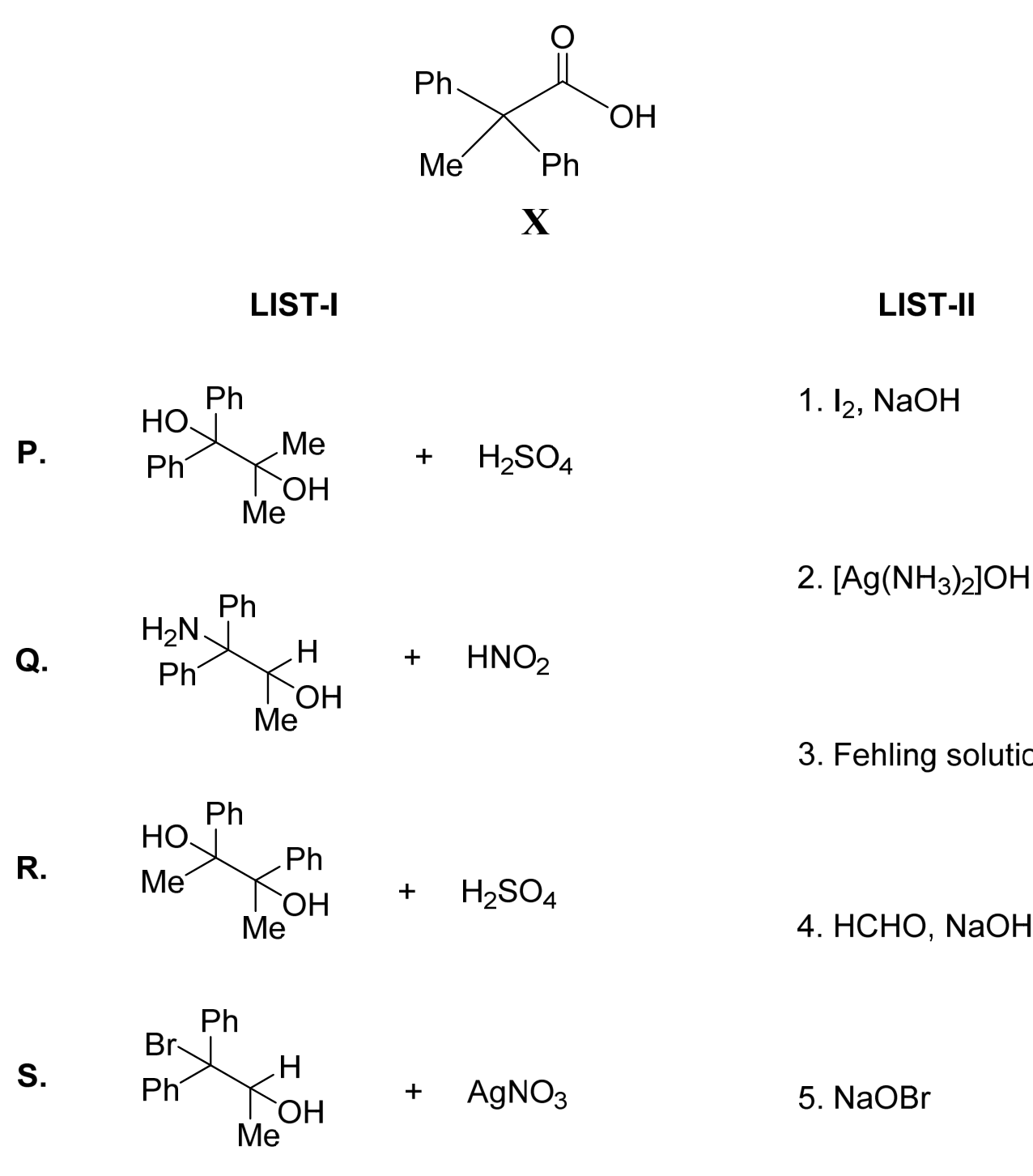
The target product X can be produced by treating the primary product of the reactions specified in LIST-I with one or more suitable reagents from LIST-II.
To determine the correct set of reagents required to produce the target product X from the primary products of reactions in LIST-I, let us analyze the target molecule and each reaction step by step.
1. Target Molecule (X)
The target compound X is 2,2-diphenylpropanoic acid:
X=Ph2C(CH3)COOH
Protonation occurs preferentially at the −OH group attached to the diphenyl-substituted carbon because loss of water yields a highly stable dibenzylic carbocation:
Ph2C(OH)−C(CH3)2OHH+Ph2C+−C(CH3)2OH+H2O
A methyl group migrates from the adjacent carbon to the carbocation carbon to form a resonance-stabilized oxocarbocation:
Ph2C+−C(CH3)2OH∼CH3−Ph2C(CH3)−C+(OH)CH3−H+Ph2C(CH3)COCH3
The primary product is the methyl ketone, 3,3-diphenylbutan-2-one (Ph2C(CH3)COCH3).
To convert this methyl ketone into the carboxylic acid X, a haloform reaction is required:
Reaction of −NH2 with HNO2 forms a diazonium ion −N2+, which departs immediately to generate a carbocation at the C-1 carbon:
Ph2C(NH2)−CH(CH3)OHHNO2Ph2C+−CH(CH3)OH+N2+H2O
According to the given migratory aptitude (aryl>alkyl>hydrogen), the alkyl (CH3) group migrates in preference to hydrogen:
Ph2C+−CH(CH3)OH∼CH3−Ph2C(CH3)−CH+(OH)−H+Ph2C(CH3)CHO
The primary product is an aldehyde, 2,2-diphenylpropanal (Ph2C(CH3)CHO).
To oxidize this aliphatic aldehyde to carboxylic acid X, standard mild oxidizing agents can be used:
Protonation of −OH and loss of water gives carbocation Ph(CH3)C+−C(OH)(CH3)Ph.
Due to migratory aptitude (aryl>alkyl), the phenyl (aryl) group migrates to the adjacent carbon:
Ph(CH3)C+−C(OH)(CH3)Ph∼Ph−Ph2C(CH3)−C+(OH)CH3−H+Ph2C(CH3)COCH3
The primary product is the same methyl ketone (Ph2C(CH3)COCH3) as in Reaction P.
Haloform oxidation using reagents 1 (I2,NaOH) and 5 (NaOBr) yields the carboxylic acid X.
Ag+ precipitates Br− as AgBr, generating the exact same carbocation intermediate as formed in Reaction Q:
Ph2C(Br)−CH(CH3)OHAg+Ph2C+−CH(CH3)OH+AgBr
Following migratory aptitude (alkyl>hydrogen), the methyl group migrates to yield the aldehydePh2C(CH3)CHO.
Oxidation using reagents 2 ([Ag(NH3)2]OH) and 3 (Fehling solution) gives X.