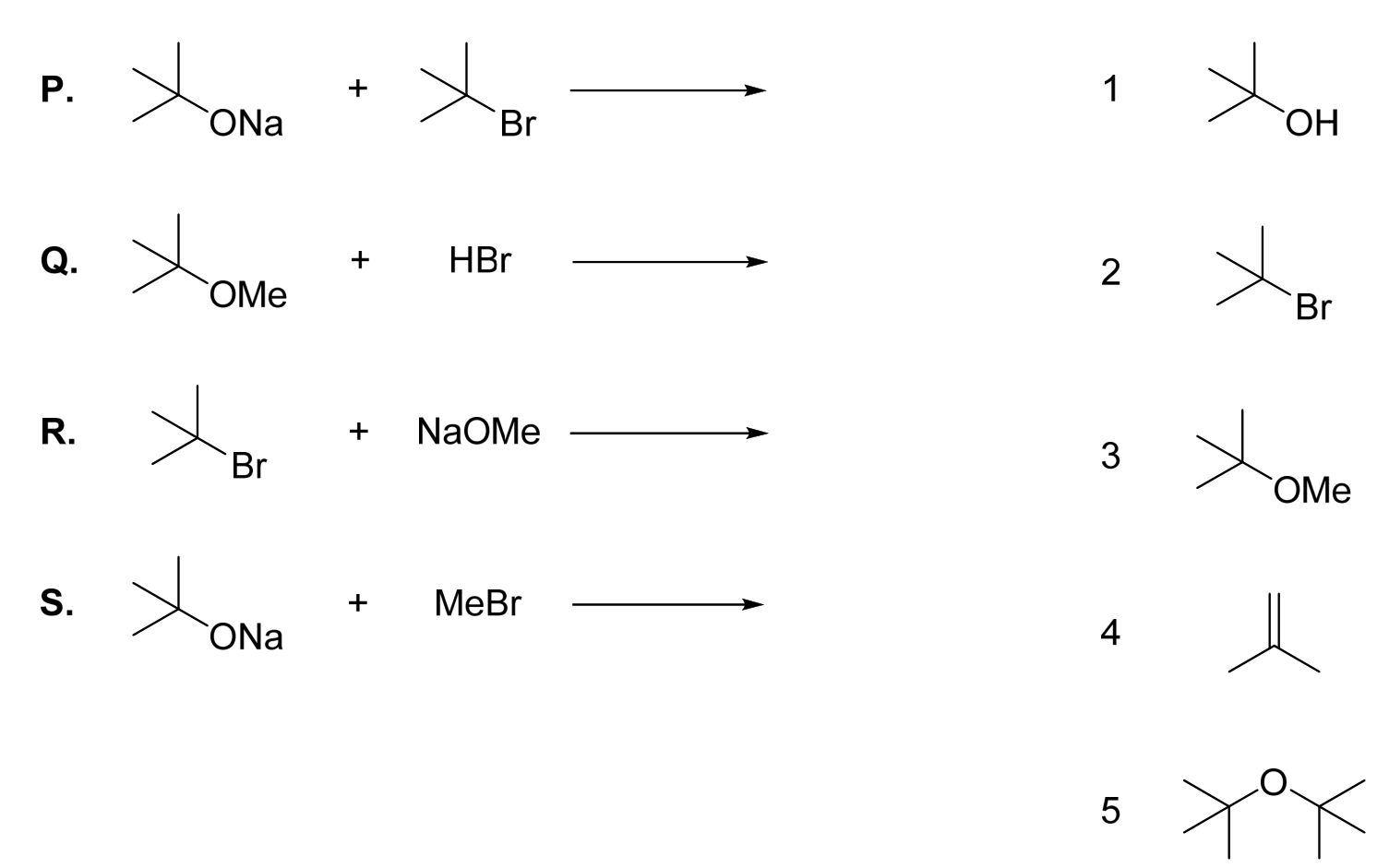
Mechanism: Protonation of oxygen by HBr gives the oxonium ion [tert-Bu−O+H−Me]. Since the tert-butyl group forms a highly stable 3∘ carbocation, cleavage occurs via an SN1 mechanism.
Outcome: Loss of methanol (MeOH) forms tert-Bu+, which is subsequently attacked by Br−:
tert-Bu−O+H−Me−MeOHtert-Bu+Br−tert-BuBr (2)
Products:tert-BuBr (Compound 2)
Q→2
3. Reaction R
tert-BuBr+NaOMe⟶
Mechanism: Sodium methoxide (NaOMe) is a strong base. Reaction of a 3∘ alkyl halide (tert-BuBr) with a strong base proceeds almost exclusively via E2 elimination because SN2 is sterically impossible on a tertiary carbon.
Mechanism: Methyl bromide (MeBr) has no β-hydrogens, so elimination is impossible. This is a classic Williamson ether synthesis where the bulky alkoxide (tert-BuO−) acts as a nucleophile attacking the unhindered methyl carbon via an SN2 pathway.