Potential Energy Net Value for Hydrogen Molecule Ground State
The graph below illustrates potential energy against internuclear distance () for an molecule in its electronic ground state. Find the net potential energy (in ) at where electron-electron repulsion and nucleus-nucleus repulsion energies are absent. Take the potential energy of an isolated atom as zero when its electron and nucleus are separated infinitely. Use Avogadro's constant as .
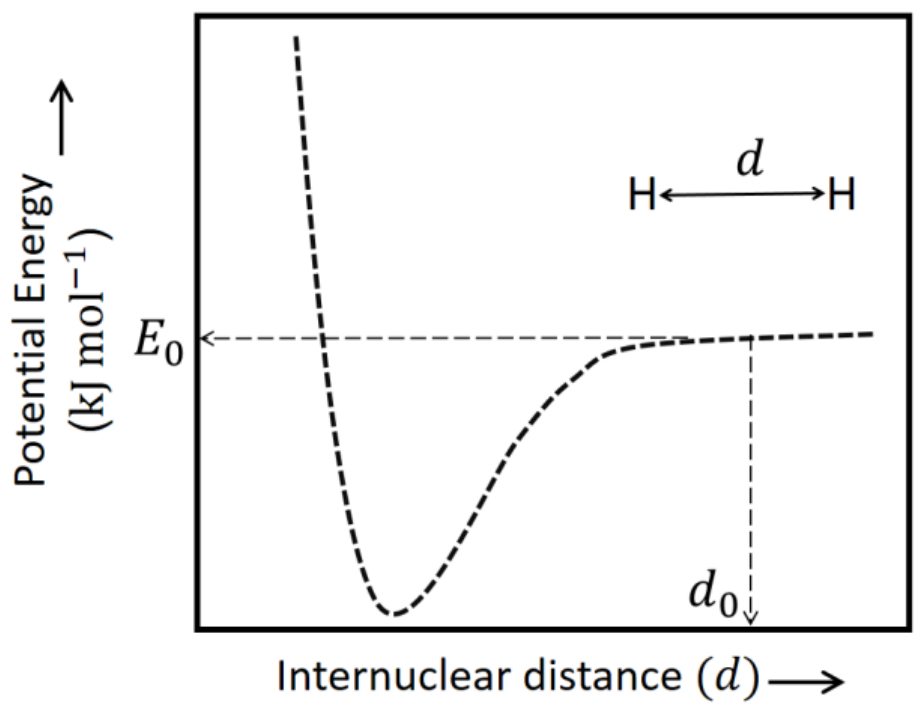
Step-by-Step Solution
To find the net potential energy (in ) of an molecule at internuclear distance where interatomic repulsions (electron-electron and nucleus-nucleus) are absent, we consider two isolated, non-interacting hydrogen atoms in their electronic ground state ().
Step 1: Potential Energy of a Single Ground-State Hydrogen Atom
According to the Bohr model of the hydrogen atom, the total energy of an electron in the ground state () is:
The total energy is the sum of the kinetic energy and the potential energy :
For a inverse-square force law (Coulomb potential), by the Virial Theorem:
Thus, the potential energy of a single hydrogen atom is twice its total ground-state energy:
Step 2: Potential Energy of the Two Non-Interacting H Atoms
At , the two hydrogen atoms are sufficiently far apart such that interatomic repulsion and attraction terms are absent. Therefore, the system consists of two independent hydrogen atoms.
The potential energy per pair of H atoms ( molecule at ) is:
Step 3: Conversion to
We convert the potential energy from per molecule to using the fundamental constants:
Substituting the values:
Final Answer:
The net potential energy at is (or approximately ).