JEE Challenger
More from Amines

Calculate Mass of Product Q in Organic Reaction Sequence

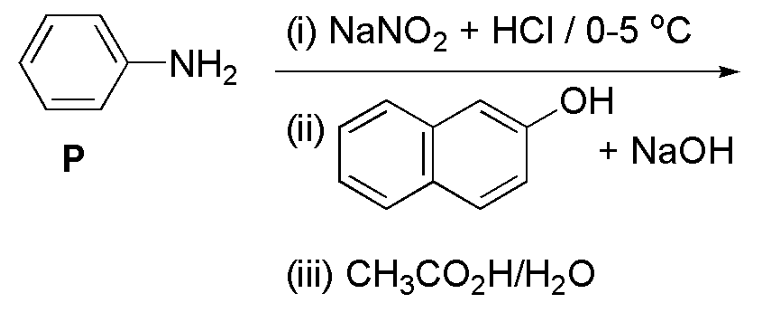
Consider the conversion sequence from P\mathbf{P} to Q\mathbf{Q} illustrated below. The overall reaction yield for obtaining product Q\mathbf{Q} starting from P\mathbf{P} is 75%75\%. Find the mass in grams of Q\mathbf{Q} formed when 9.3 mL9.3\text{ mL} of reactant P\mathbf{P} is used. (Given data: density of P=1.00 g mL−1\mathbf{P} = 1.00\text{ g mL}^{-1}; Molar masses: C=12.0\text{C} = 12.0, H=1.0\text{H} = 1.0, O=16.0\text{O} = 16.0, N=14.0 g mol−1\text{N} = 14.0\text{ g mol}^{-1})

Question Diagram 1
Official Numerical Answer18.6

Step-by-Step Solution

To find the mass of product Q\mathbf{Q} formed in the given reaction sequence, we proceed step-by-step:

Step 1: Identification of Reactants and Products

  1. Reactant P\mathbf{P}: The starting material is aniline, C6H5NH2\text{C}_6\text{H}_5\text{NH}_2.

    • Molecular formula: C6H7N\text{C}_6\text{H}_7\text{N}
    • Molar mass of P=(6×12.0)+(7×1.0)+(1×14.0)=72.0+7.0+14.0=93.0 g mol−1\mathbf{P} = (6 \times 12.0) + (7 \times 1.0) + (1 \times 14.0) = 72.0 + 7.0 + 14.0 = 93.0\text{ g mol}^{-1}
  2. Reaction Sequence:

    • (i) Diazotization: Aniline (P\mathbf{P}) reacts with NaNO2+HCl\text{NaNO}_2 + \text{HCl} at 0–5∘C0\text{--}5^\circ\text{C} to form benzene diazonium chloride (C6H5N2+Cl−\text{C}_6\text{H}_5\text{N}_2^+\text{Cl}^-).
    • (ii) Azo Coupling: Benzene diazonium chloride undergoes a coupling reaction with 2-naphthol in alkaline medium (NaOH\text{NaOH}) at the electrophilic 1-position.
    • (iii) Acidification: Acidification with CH3CO2H/H2O\text{CH}_3\text{CO}_2\text{H}/\text{H}_2\text{O} yields the neutral azo dye product Q\mathbf{Q}, 1-(phenylazo)-2-naphthol.
  3. Product Q\mathbf{Q}:

    • Chemical formula: C6H5–N=N–C10H6OH\text{C}_6\text{H}_5\text{--}\text{N}=\text{N}\text{--}\text{C}_{10}\text{H}_6\text{OH}, which simplifies to C16H12N2O\text{C}_{16}\text{H}_{12}\text{N}_2\text{O}.
    • Molar mass of Q=(16×12.0)+(12×1.0)+(2×14.0)+(1×16.0)\mathbf{Q} = (16 \times 12.0) + (12 \times 1.0) + (2 \times 14.0) + (1 \times 16.0) Molar mass of Q=192.0+12.0+28.0+16.0=248.0 g mol−1\text{Molar mass of }\mathbf{Q} = 192.0 + 12.0 + 28.0 + 16.0 = 248.0\text{ g mol}^{-1}

Step 2: Calculate the Moles of Reactant P\mathbf{P} Used

Given:

  • Volume of P=9.3 mL\mathbf{P} = 9.3\text{ mL}
  • Density of P=1.00 g mL−1\mathbf{P} = 1.00\text{ g mL}^{-1}

Mass of P=Volume×Density=9.3 mL×1.00 g mL−1=9.3 g\text{Mass of }\mathbf{P} = \text{Volume} \times \text{Density} = 9.3\text{ mL} \times 1.00\text{ g mL}^{-1} = 9.3\text{ g}

Moles of P=Mass of PMolar mass of P=9.3 g93.0 g mol−1=0.1 mol\text{Moles of }\mathbf{P} = \frac{\text{Mass of }\mathbf{P}}{\text{Molar mass of }\mathbf{P}} = \frac{9.3\text{ g}}{93.0\text{ g mol}^{-1}} = 0.1\text{ mol}


Step 3: Calculate the Mass of Product Q\mathbf{Q} Obtained

From the stoichiometry of the reaction, 1 mole1\text{ mole} of aniline (P\mathbf{P}) ideally produces 1 mole1\text{ mole} of product Q\mathbf{Q}.

  • Theoretical moles of Q=0.1 mol\mathbf{Q} = 0.1\text{ mol}
  • Given reaction yield = 75%75\%

Actual moles of Q=0.1 mol×75100=0.075 mol\text{Actual moles of }\mathbf{Q} = 0.1\text{ mol} \times \frac{75}{100} = 0.075\text{ mol}

Mass of Q=Actual moles of Q×Molar mass of Q\text{Mass of }\mathbf{Q} = \text{Actual moles of }\mathbf{Q} \times \text{Molar mass of }\mathbf{Q} Mass of Q=0.075 mol×248.0 g mol−1=18.6 g\text{Mass of }\mathbf{Q} = 0.075\text{ mol} \times 248.0\text{ g mol}^{-1} = 18.6\text{ g}

Final Answer:

The mass of product Q\mathbf{Q} formed is 18.6 g18.6\text{ g}.