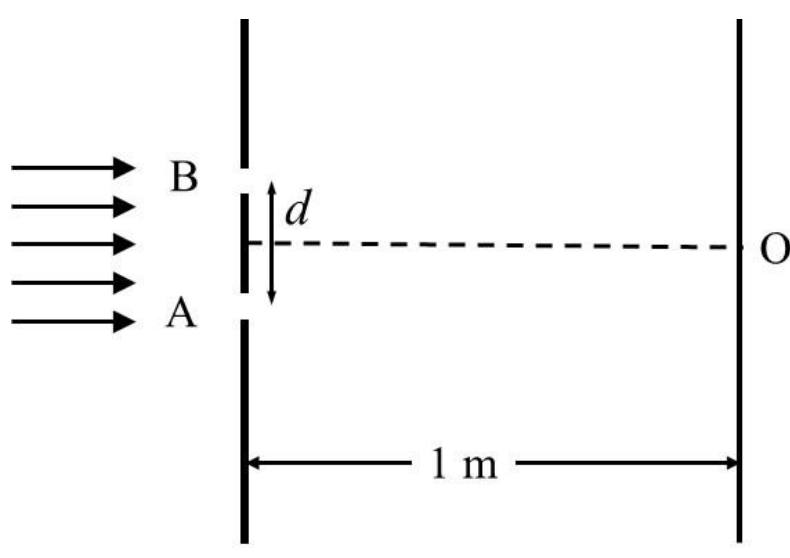
To find the separation between the two extreme positions of the 8 th 8^{\text{th}} 8 th
1. Expression for the Position of the 8 th 8^{\text{th}} 8 th In Young's double slit experiment, the distance of the n th n^{\text{th}} n th y n ( t ) = n λ D d ( t ) y_n(t) = \frac{n \lambda D}{d(t)} y n ( t ) = d ( t ) nλ D
Given parameters:
Order of fringe, n = 8 n = 8 n = 8
Wavelength of light, λ = 6000 A ˚ = 6 × 10 − 7 m \lambda = 6000 \text{ \AA} = 6 \times 10^{-7} \text{ m} λ = 6000 A ˚ = 6 × 1 0 − 7 m
Distance between slits and screen, D = 1 m D = 1 \text{ m} D = 1 m
Distance between slits, d ( t ) = ( 0.8 + 0.04 sin ω t ) mm d(t) = (0.8 + 0.04 \sin \omega t) \text{ mm} d ( t ) = ( 0.8 + 0.04 sin ω t ) mm
Thus, the position of the 8 th 8^{\text{th}} 8 th t t t y 8 ( t ) = 8 λ D d ( t ) y_8(t) = \frac{8 \lambda D}{d(t)} y 8 ( t ) = d ( t ) 8 λ D
2. Extreme Values of Slit Separation d d d Since the function sin ω t \sin \omega t sin ω t − 1 -1 − 1 + 1 +1 + 1 d ( t ) d(t) d ( t )
Minimum separation: d min = 0.8 − 0.04 = 0.76 mm = 0.76 × 10 − 3 m d_{\text{min}} = 0.8 - 0.04 = 0.76 \text{ mm} = 0.76 \times 10^{-3} \text{ m} d min = 0.8 − 0.04 = 0.76 mm = 0.76 × 1 0 − 3 m
Maximum separation: d max = 0.8 + 0.04 = 0.84 mm = 0.84 × 10 − 3 m d_{\text{max}} = 0.8 + 0.04 = 0.84 \text{ mm} = 0.84 \times 10^{-3} \text{ m} d max = 0.8 + 0.04 = 0.84 mm = 0.84 × 1 0 − 3 m
3. Extreme Positions of the 8 th 8^{\text{th}} 8 th The extreme positions of the fringe correspond to d min d_{\text{min}} d min d max d_{\text{max}} d max
Maximum distance from O (y 8 , max y_{8, \text{max}} y 8 , max
y 8 , max = 8 λ D d min = 8 × ( 6 × 10 − 7 m ) × 1 m 0.76 × 10 − 3 m = 4.8 × 10 − 3 0.76 m y_{8, \text{max}} = \frac{8 \lambda D}{d_{\text{min}}} = \frac{8 \times (6 \times 10^{-7} \text{ m}) \times 1 \text{ m}}{0.76 \times 10^{-3} \text{ m}} = \frac{4.8 \times 10^{-3}}{0.76} \text{ m} y 8 , max = d min 8 λ D = 0.76 × 1 0 − 3 m 8 × ( 6 × 1 0 − 7 m ) × 1 m = 0.76 4.8 × 1 0 − 3 m
Minimum distance from O (y 8 , min y_{8, \text{min}} y 8 , min
y 8 , min = 8 λ D d max = 8 × ( 6 × 10 − 7 m ) × 1 m 0.84 × 10 − 3 m = 4.8 × 10 − 3 0.84 m y_{8, \text{min}} = \frac{8 \lambda D}{d_{\text{max}}} = \frac{8 \times (6 \times 10^{-7} \text{ m}) \times 1 \text{ m}}{0.84 \times 10^{-3} \text{ m}} = \frac{4.8 \times 10^{-3}}{0.84} \text{ m} y 8 , min = d max 8 λ D = 0.84 × 1 0 − 3 m 8 × ( 6 × 1 0 − 7 m ) × 1 m = 0.84 4.8 × 1 0 − 3 m
4. Separation Between the Extreme Positions The separation Δ y \Delta y Δ y Δ y = y 8 , max − y 8 , min = 8 λ D ( 1 d min − 1 d max ) \Delta y = y_{8, \text{max}} - y_{8, \text{min}} = 8 \lambda D \left( \frac{1}{d_{\text{min}}} - \frac{1}{d_{\text{max}}} \right) Δ y = y 8 , max − y 8 , min = 8 λ D ( d min 1 − d max 1 )
Substitute the numerical values:
Δ y = 4.8 × 10 − 3 ( 1 0.76 × 10 − 3 − 1 0.84 × 10 − 3 ) m \Delta y = 4.8 \times 10^{-3} \left( \frac{1}{0.76 \times 10^{-3}} - \frac{1}{0.84 \times 10^{-3}} \right) \text{ m} Δ y = 4.8 × 1 0 − 3 ( 0.76 × 1 0 − 3 1 − 0.84 × 1 0 − 3 1 ) m
Δ y = 4.8 ( 0.84 − 0.76 0.76 × 0.84 ) mm \Delta y = 4.8 \left( \frac{0.84 - 0.76}{0.76 \times 0.84} \right) \text{ mm} Δ y = 4.8 ( 0.76 × 0.84 0.84 − 0.76 ) mm
Δ y = 4.8 × 0.08 0.6384 mm = 0.384 0.6384 mm \Delta y = 4.8 \times \frac{0.08}{0.6384} \text{ mm} = \frac{0.384}{0.6384} \text{ mm} Δ y = 4.8 × 0.6384 0.08 mm = 0.6384 0.384 mm
Δ y ≈ 0.6015037 mm = 601.5037 μ m \Delta y \approx 0.6015037 \text{ mm} = 601.5037 \text{ }\mu\text{m} Δ y ≈ 0.6015037 mm = 601.5037 μ m
Rounding off to two decimal places:
Δ y ≈ 601.50 μ m \Delta y \approx 601.50 \text{ }\mu\text{m} Δ y ≈ 601.50 μ m
(Note: Using first-order differential approximation Δ y ≈ ∣ d y 8 d d ∣ Δ d = 8 λ D d 0 2 ( 2 Δ d ) = 4.8 × 10 − 3 ( 0.8 ) 2 × 0.08 = 600 μ m \Delta y \approx \left|\frac{dy_8}{dd}\right| \Delta d = \frac{8 \lambda D}{d_0^2} (2 \Delta d) = \frac{4.8 \times 10^{-3}}{(0.8)^2} \times 0.08 = 600 \text{ }\mu\text{m} Δ y ≈ dd d y 8 Δ d = d 0 2 8 λ D ( 2Δ d ) = ( 0.8 ) 2 4.8 × 1 0 − 3 × 0.08 = 600 μ m