JEE Challenger
More from Wave Optics

Maximum Speed of Eighth Bright Fringe in Oscillating Double Slit

Comprehension Passage

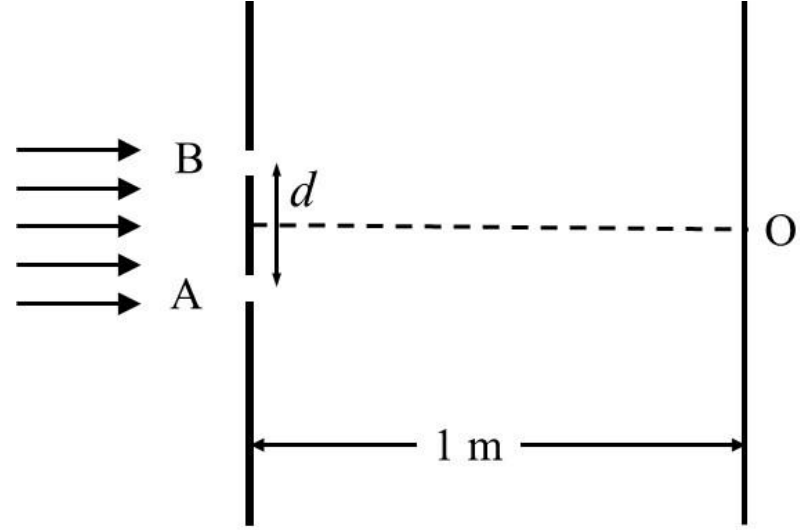
In a Young's double slit experiment, each of the two slits A and B, as shown in the figure, are oscillating about their fixed center and with a mean separation of 0.8 mm0.8\text{ mm}. The distance between the slits at time tt is given by d=(0.8+0.04sinωt) mmd = (0.8 + 0.04 \sin \omega t)\text{ mm}, where ω=0.08 rad s1\omega = 0.08\text{ rad s}^{-1}. The distance of the screen from the slits is 1 m1\text{ m} and the wavelength of the light used to illuminate the slits is 6000 A˚6000\text{ \AA}. The interference pattern on the screen changes with time, while the central bright fringe (zeroth fringe) remains fixed at point O.

The maximum speed in μm/s\mu\text{m/s} at which the 8th8^{\text{th}} bright fringe will move is ________.

Question Diagram 1
Official Numerical Answer24 to 24.12

Step-by-Step Solution

To find the maximum speed at which the 8th8^{\text{th}} bright fringe moves, we start with the position of the nthn^{\text{th}} bright fringe in Young's Double Slit Experiment.

The position yn(t)y_n(t) of the nthn^{\text{th}} bright fringe from the central maximum on the screen is given by: yn(t)=nλDd(t)y_n(t) = \frac{n \lambda D}{d(t)}

For the 8th8^{\text{th}} bright fringe (n=8n = 8): y8(t)=8λDd(t)y_8(t) = \frac{8 \lambda D}{d(t)}

Given parameters:

  • Wavelength of light, λ=6000 A˚=6×10⁷ m\lambda = 6000\text{ \AA} = 6 \times 10^{-7}\text{ m}
  • Distance of screen, D=1 mD = 1\text{ m}
  • Slit separation, d(t)=(0.8+0.04sinωt) mm=(0.8+0.04sinωt)×103 md(t) = (0.8 + 0.04 \sin \omega t)\text{ mm} = (0.8 + 0.04 \sin \omega t) \times 10^{-3}\text{ m}
  • Angular frequency, ω=0.08 rad s1\omega = 0.08\text{ rad s}^{-1}

Step 1: Velocity of the 8th8^{\text{th}} Bright Fringe

Differentiating y8(t)y_8(t) with respect to time tt: v8(t)=dy8(t)dt=8λD[d(t)]2dd(t)dtv_8(t) = \frac{d y_8(t)}{dt} = -\frac{8 \lambda D}{[d(t)]^2} \cdot \frac{d d(t)}{dt}

Now, calculating dd(t)dt\frac{d d(t)}{dt}: dd(t)dt=ddt[(0.8+0.04sinωt)×103]=0.04ωcos(ωt)×103 m/s\frac{d d(t)}{dt} = \frac{d}{dt} \left[ (0.8 + 0.04 \sin \omega t) \times 10^{-3} \right] = 0.04 \omega \cos(\omega t) \times 10^{-3}\text{ m/s}

Substituting this into the velocity expression gives: v8(t)=8λD(0.04×10³ωcosωt)[d(t)]2v_8(t) = -\frac{8 \lambda D \cdot (0.04 \times 10^{-3} \omega \cos \omega t)}{[d(t)]^2}

Step 2: Maximum Speed Calculation

The magnitude of the speed is: v8(t)=8λD×(0.04×103)ωcosωt[(0.8+0.04sinωt)×103]2|v_8(t)| = \frac{8 \lambda D \times (0.04 \times 10^{-3}) \omega |\cos \omega t|}{[(0.8 + 0.04 \sin \omega t) \times 10^{-3}]^2}

Substituting the known values into the numerator: Numerator=8×(6×107 m)×1 m×(0.04×103 m)×0.08 s1=15.36×10¹² m3/s\text{Numerator} = 8 \times (6 \times 10^{-7}\text{ m}) \times 1\text{ m} \times (0.04 \times 10^{-3}\text{ m}) \times 0.08\text{ s}^{-1} = 15.36 \times 10^{-12}\text{ m}^3\text{/s}

Since the amplitude of slit separation oscillation (0.04 mm0.04\text{ mm}) is much smaller than the mean slit separation (0.8 mm0.8\text{ mm}), i.e., 0.04 mm0.8 mm0.04\text{ mm} \ll 0.8\text{ mm}, we can approximate d(t)0.8 mm=0.8×10³ md(t) \approx 0.8\text{ mm} = 0.8 \times 10^{-3}\text{ m}.

The maximum value of cosωt=1|\cos \omega t| = 1. Therefore, the maximum speed is: v8max15.36×1012(0.8×10³)2=15.36×10120.64×106=24×106 m/s=24 μm/s|v_8|_{\max} \approx \frac{15.36 \times 10^{-12}}{(0.8 \times 10^{-3})^2} = \frac{15.36 \times 10^{-12}}{0.64 \times 10^{-6}} = 24 \times 10^{-6}\text{ m/s} = 24\text{ }\mu\text{m/s}

(Note: Without approximation, maximizing f(t)=cosωt(0.8+0.04sinωt)2f(t) = \frac{|\cos \omega t|}{(0.8 + 0.04 \sin \omega t)^2} yields sinωt0.0995\sin \omega t \approx -0.0995 and v8max24.12 μm/s|v_8|_{\max} \approx 24.12\text{ }\mu\text{m/s}.)

Thus, the maximum speed of the 8th8^{\text{th}} bright fringe is 24 (or 24.12).

Maximum Speed of Eighth Bright Fringe in Oscillating Double Slit | Physics PYQ Solution - JEE Challenger