JEE Challenger
More from Hydrocarbons

Optical Inactivity of Compounds Obtained by Hydrogenation

Which among the following compound(s) yields optically inactive product(s) upon complete hydrogenation?

Options

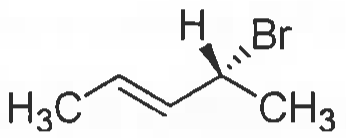
A
Option A Diagram 1
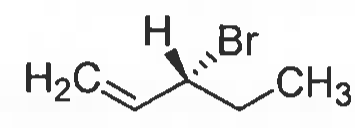
B
Option B Diagram 1
Correct
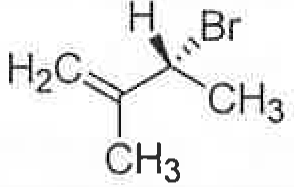
C
Option C Diagram 1
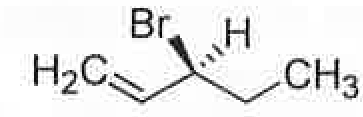
D
Option D Diagram 1
Correct

Step-by-Step Solution

To determine which compound(s) yield optically inactive product(s) upon complete hydrogenation, we analyze the structure of the hydrogenation product for each option:


Option (A)

  • Given Compound: 4-bromopent-2-ene4\text{-bromopent-2-ene} CH3−CH=CH−CH(Br)−CH3\text{CH}_3-\text{CH}=\text{CH}-\text{CH}(\text{Br})-\text{CH}_3

  • Hydrogenation Reaction: CH3−CH=CH−CH(Br)−CH3+H2→Pd/CCH3−CH2−CH2−CH∗(Br)−CH3\text{CH}_3-\text{CH}=\text{CH}-\text{CH}(\text{Br})-\text{CH}_3 + \text{H}_2 \xrightarrow{\text{Pd/C}} \text{CH}_3-\text{CH}_2-\text{CH}_2-\text{CH}^*(\text{Br})-\text{CH}_3

  • Product Analysis: The product formed is 2-bromopentane2\text{-bromopentane}. The carbon C∗\text{C}^* (at position 2) is bonded to four different groups:

    1. −H-\text{H}
    2. −Br-\text{Br}
    3. −CH3-\text{CH}_3
    4. −CH2CH2CH3-\text{CH}_2\text{CH}_2\text{CH}_3 (n-propyl group)

Since C∗\text{C}^* is an asymmetric chiral center and the molecule lacks any plane or center of symmetry, 2-bromopentane2\text{-bromopentane} is chiral and optically active.


Option (B)

  • Given Compound: (R) or (S)-3-bromopent-1-ene(R)\text{ or }(S)\text{-}3\text{-bromopent-1-ene} H2C=CH−CH(Br)−CH2−CH3\text{H}_2\text{C}=\text{CH}-\text{CH}(\text{Br})-\text{CH}_2-\text{CH}_3

  • Hydrogenation Reaction: H2C=CH−CH(Br)−CH2−CH3+H2→Pd/CCH3−CH2−CH(Br)−CH2−CH3\text{H}_2\text{C}=\text{CH}-\text{CH}(\text{Br})-\text{CH}_2-\text{CH}_3 + \text{H}_2 \xrightarrow{\text{Pd/C}} \text{CH}_3-\text{CH}_2-\text{CH}(\text{Br})-\text{CH}_2-\text{CH}_3

  • Product Analysis: The product formed is 3-bromopentane3\text{-bromopentane}. The central carbon (C3\text{C3}) is attached to:

    1. −H-\text{H}
    2. −Br-\text{Br}
    3. −CH2CH3-\text{CH}_2\text{CH}_3 (ethyl group)
    4. −CH2CH3-\text{CH}_2\text{CH}_3 (ethyl group)

Because two of the attached groups are identical (both are ethyl groups), C3\text{C3} is not a chiral center. The molecule possesses a plane of symmetry passing through C3\text{C3}, H\text{H}, and Br\text{Br}. Thus, 3-bromopentane3\text{-bromopentane} is achiral and optically inactive.


Option (C)

  • Given Compound: 3-bromo-2-methylbut-1-ene3\text{-bromo-2-methylbut-1-ene} H2C=C(CH3)−CH(Br)−CH3\text{H}_2\text{C}=\text{C}(\text{CH}_3)-\text{CH}(\text{Br})-\text{CH}_3

  • Hydrogenation Reaction: H2C=C(CH3)−CH(Br)−CH3+H2→Pd/CCH3−CH(CH3)−CH∗(Br)−CH3\text{H}_2\text{C}=\text{C}(\text{CH}_3)-\text{CH}(\text{Br})-\text{CH}_3 + \text{H}_2 \xrightarrow{\text{Pd/C}} \text{CH}_3-\text{CH}(\text{CH}_3)-\text{CH}^*(\text{Br})-\text{CH}_3

  • Product Analysis: The product formed is 2-bromo-3-methylbutane2\text{-bromo-3-methylbutane}. The carbon C∗\text{C}^* (at position 2) is attached to four distinct groups:

    1. −H-\text{H}
    2. −Br-\text{Br}
    3. −CH3-\text{CH}_3
    4. −CH(CH3)2-\text{CH}(\text{CH}_3)_2 (isopropyl group)

Since C∗\text{C}^* is a chiral center, 2-bromo-3-methylbutane2\text{-bromo-3-methylbutane} is chiral and optically active.


Option (D)

  • Given Compound: Enantiomer of 3-bromopent-1-ene3\text{-bromopent-1-ene} H2C=CH−CH(Br)−CH2−CH3\text{H}_2\text{C}=\text{CH}-\text{CH}(\text{Br})-\text{CH}_2-\text{CH}_3

  • Hydrogenation Reaction: H2C=CH−CH(Br)−CH2−CH3+H2→Pd/CCH3−CH2−CH(Br)−CH2−CH3\text{H}_2\text{C}=\text{CH}-\text{CH}(\text{Br})-\text{CH}_2-\text{CH}_3 + \text{H}_2 \xrightarrow{\text{Pd/C}} \text{CH}_3-\text{CH}_2-\text{CH}(\text{Br})-\text{CH}_2-\text{CH}_3

  • Product Analysis: Just as in Option (B), complete hydrogenation converts the terminal alkenyl group into an ethyl group, yielding 3-bromopentane3\text{-bromopentane}. As established, 3-bromopentane3\text{-bromopentane} contains two identical ethyl groups on the central carbon and is therefore achiral and optically inactive.


Conclusion

Compounds (B) and (D) both produce 3-bromopentane3\text{-bromopentane}, which is an achiral, optically inactive compound upon complete hydrogenation.
Correct Options: B and D