Number of Reactions Yielding Benzaldehyde
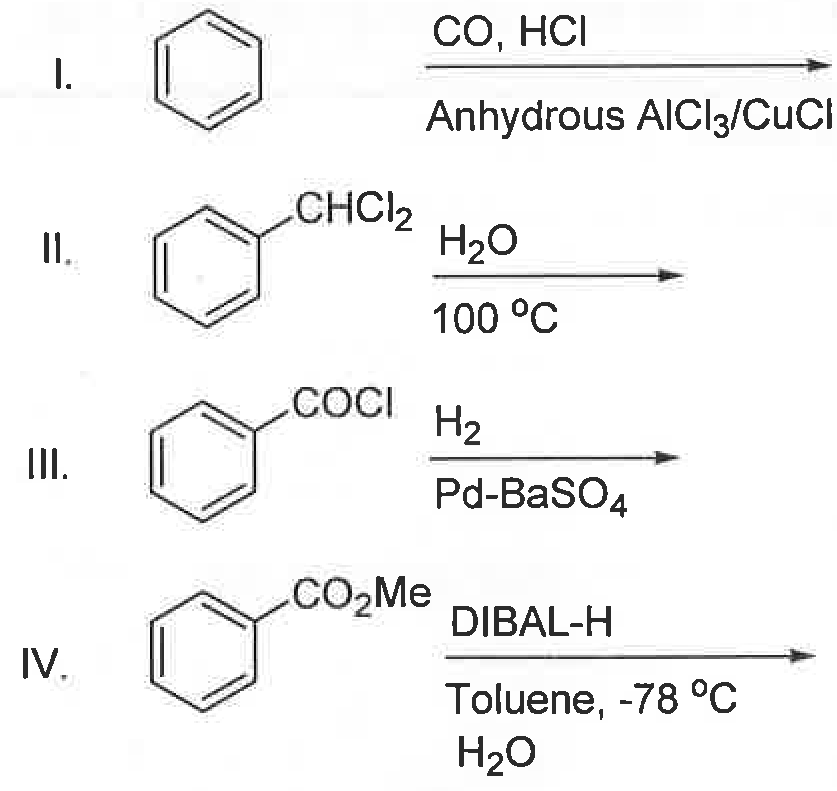
Among the chemical transformations shown below, identify the number of reaction(s) that produce benzaldehyde as a major product:
Step-by-Step Solution
To find the number of reactions that yield benzaldehyde () as a major product, we analyze each reaction individually:
-
Reaction I: Gattermann–Koch Reaction Benzene reacts with carbon monoxide and hydrogen chloride gas in the presence of anhydrous aluminum chloride and cuprous chloride () to form formyl chloride in situ, which subsequently undergoes electrophilic aromatic substitution to produce benzaldehyde. Produces benzaldehyde.
-
Reaction II: Hydrolysis of Benzal Chloride Hydrolysis of benzal chloride (a geminal dihalide) at elevated temperatures replaces both chlorine atoms with hydroxyl groups to form an unstable gem-diol intermediate, which rapidly loses a molecule of water to yield benzaldehyde. Produces benzaldehyde.
-
Reaction III: Rosenmund Reduction Benzoyl chloride is catalytically hydrogenated over palladium supported on barium sulfate (poisoned catalyst). The poisoned catalyst prevents further reduction of the aldehyde to the primary alcohol, successfully yielding benzaldehyde as the major product. Produces benzaldehyde.
-
Reaction IV: Controlled Reduction of an Ester by DIBAL-H Diisobutylaluminium hydride () is a bulky, electrophilic reducing agent. When reacted with an ester (methyl benzoate) at a low temperature (), reduction stops at the hemiacetal-like tetrahedral intermediate, which on aqueous workup hydrolyzes to form benzaldehyde. Produces benzaldehyde.
Since all four reactions (I, II, III, and IV) yield benzaldehyde, the total number of reactions is 4.