Number of Collisions for Particles in Circular Orbit to Return to Starting Point
Two small particles of equal masses start moving in opposite directions from a point in a horizontal circular orbit. Their tangential velocities are and , respectively, as shown in the figure.
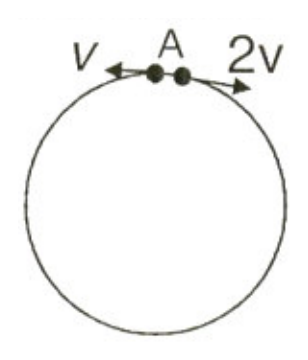
Between collisions, the particles move with constant speeds. After making how many elastic collisions, other than that at , these two particles will again reach the point ?
Options
4
3
2
1
Topics & Concepts
Step-by-Step Solution
To determine the number of collisions the particles make before returning to point , we analyze the motion along the circular path:
-
Exchange of Velocities in Elastic Collisions:
Since the two particles have identical masses () and undergo head-on elastic collisions along the circular path, they simply exchange their velocities upon each collision.Because velocities are exchanged, the system behaves kinematically as if two virtual particles pass straight through each other without interacting. Therefore, the positions and times of the collisions correspond precisely to the instances where two non-interacting particles (moving in opposite directions with constant speeds and ) cross paths.
-
Time Between Successive Collisions:
Let the circumference of the circular orbit be .
The particles move in opposite directions, so their relative speed of approach is:
The time interval between any two consecutive collisions is the time taken to cover a relative distance of :
-
Locations of the Collisions:
Let point be the origin , with the clockwise direction taken as positive.
The particle moving clockwise travels at speed . In each time interval , it covers a distance of:
Therefore, the positions of the successive collisions (measured clockwise from ) are:
- collision:
- collision:
- collision:
- collision:
-
Conclusion:
The particles meet again at point at the collision.
Excluding the collision that occurs at point , the number of collisions made by the particles is .
Thus, the correct option is C.