Motion of Charged Particle in Transverse Magnetic Field Region
A particle of mass and charge , moving with velocity enters Region II normal to the boundary as shown in the figure. Region II has a uniform magnetic field perpendicular to the plane of the paper. The length of the Region II is . Choose the correct choice(s).
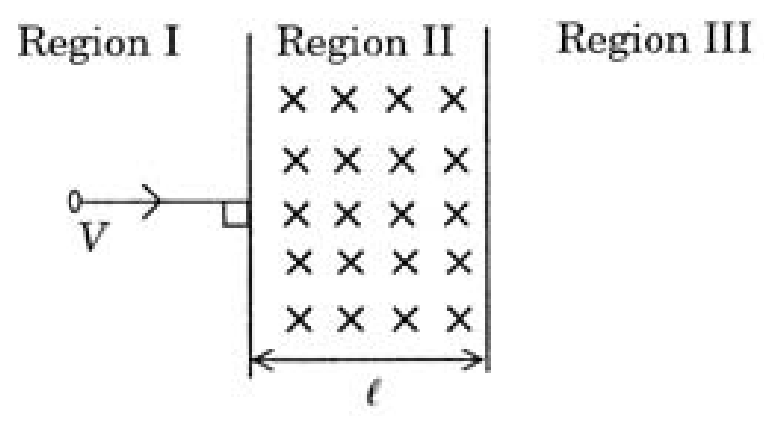
Options
The particle enters Region III only if its velocity
The particle enters Region III only if its velocity
Path length of the particle in Region II is maximum when velocity
Time spent in Region II is same for any velocity as long as the particle returns to Region I
Topics & Concepts
Step-by-Step Solution
To determine the correct options, let us analyze the motion of the charged particle in Region II step by step.
1. Trajectory and Radius of Curvature
The particle of mass and charge enters Region II at a right angle to the boundary with velocity .
The magnetic field in Region II is uniform and directed into the plane of the paper, .
The magnetic Lorentz force acting on the particle is:
This force provides the necessary centripetal acceleration, causing the particle to move along a circular path in the plane of the paper. The radius of this circular path is:
The center of this circular arc is located at in the Cartesian coordinate system where the entry point is . The equation of the path is:
The maximum displacement along the -direction (perpendicular to the boundary) is:
2. Condition to Enter Region III (Options A and B)
The width of Region II is .
- If , the particle does not reach the right boundary . It completes a semicircle and exits back into Region I through the boundary .
- If , the particle reaches the boundary and enters Region III.
Therefore, the particle enters Region III if and only if:
Hence, Option (A) is correct and Option (B) is incorrect.
3. Path Length in Region II (Option C)
Let denote the path length of the particle inside Region II:
-
For ():
The particle describes a semicircle in Region II before exiting back to Region I. The path length is:
As increases from to , the path length increases linearly from to a maximum value of:
-
For ():
The particle hits the boundary and enters Region III. The angle subtended by the arc at the center of curvature is given by:
The path length in Region II is:
Letting , we can write:
Since the function is strictly increasing for , its supremum occurs as (i.e., as ):
As (, ), . Thus, for , the path length lies in the range:
Comparing both cases, the absolute maximum path length inside Region II occurs at with a value of .
Hence, Option (C) is correct.
4. Time Spent in Region II (Option D)
As long as the particle returns to Region I, it must complete a semicircle of angular displacement .
The time spent inside Region II is equal to half the time period of circular motion:
Since this time depends only on the mass , charge , and magnetic field , it is entirely independent of the velocity .
Hence, Option (D) is correct.
Conclusion
The correct choices are (A), (C), and (D).