Binding Energy Per Nucleon and Nuclear Reactions
Assume that the nuclear binding energy per nucleon (B/A) versus mass number (A) is as shown in the figure. Use this plot to choose the correct choice(s) given below.
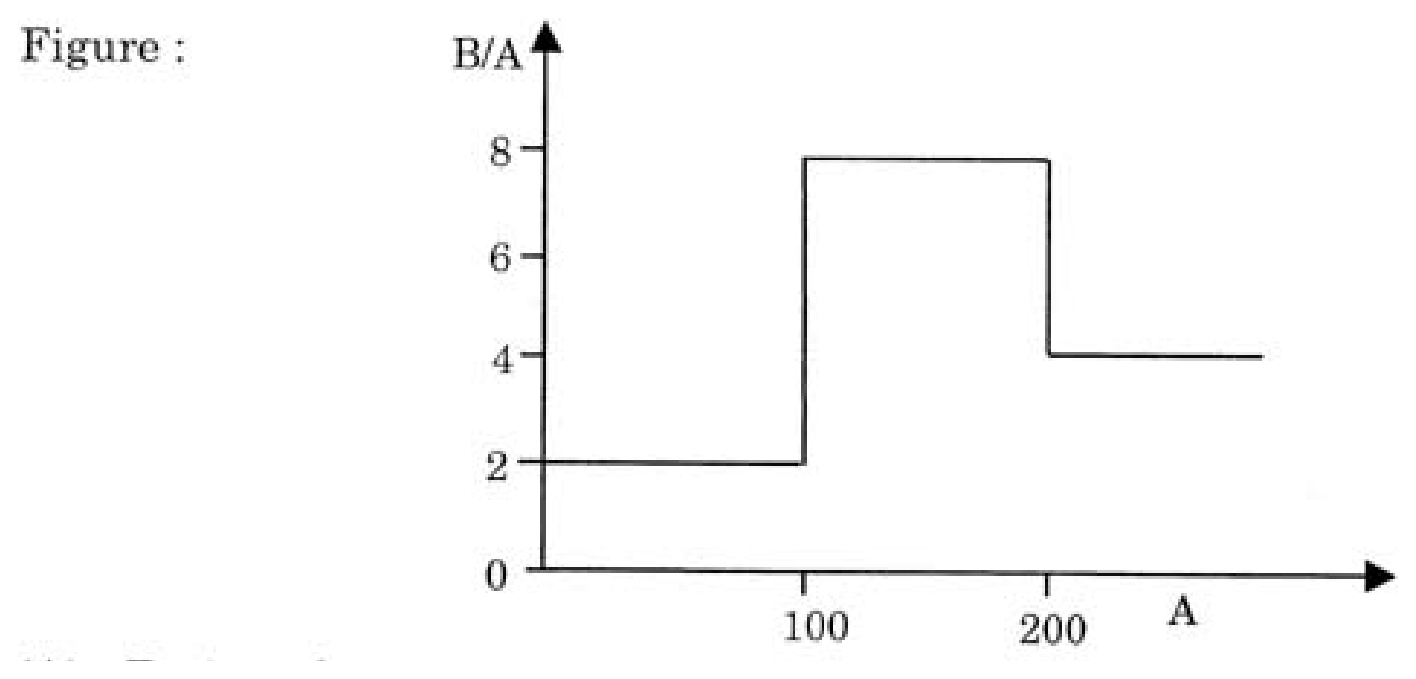
Options
Fusion of two nuclei with mass numbers lying in the range of will release energy
Fusion of two nuclei with mass numbers lying in the range of will release energy
Fission of a nucleus lying in the mass range of will release energy when broken into two equal fragments
Fission of a nucleus lying in the mass range of will release energy when broken into two equal fragments
Topics & Concepts
Step-by-Step Solution
Based on the provided plot of binding energy per nucleon versus mass number (), the values are:
- For :
- For :
- For :
A nuclear reaction (fusion or fission) releases energy () if the total binding energy of the product nuclei is greater than the total binding energy of the reactant nuclei, which means the average binding energy per nucleon increases as a result of the process:
Let us evaluate each option:
-
Option (A):
- Consider two nuclei with mass numbers and such that .
- Their combined mass number after fusion is , where .
- For all these nuclei, , so the binding energy per nucleon is constant at .
- The initial binding energy is:
- The final binding energy is:
- The energy released is:
- Thus, no energy is released. Hence, Option (A) is incorrect.
-
Option (B):
- Consider two nuclei with mass numbers and lying in the range .
- The mass number of the fused nucleus is , which falls in the range:
- For the reactants (), .
- For the product (), .
- The energy released is:
- Since , energy will be released. Hence, Option (B) is correct.
-
Option (C):
- A nucleus with mass number has .
- When it undergoes fission into two equal fragments, each fragment has a mass number , where .
- The initial binding energy is:
- The final binding energy is:
- The energy change is:
- Energy is absorbed rather than released. Hence, Option (C) is incorrect.
-
Option (D):
- A nucleus with mass number has .
- When it breaks into two equal fragments, each fragment has a mass number , where .
- The initial binding energy is:
- The final binding energy is:
- The energy released is:
- Since , energy will be released. Hence, Option (D) is correct.
Therefore, the correct choices are B and D.