Most Likely Migrating Group in Carbocation Rearrangement
In the following carbocation, that is most likely to migrate to the positively charged carbon is
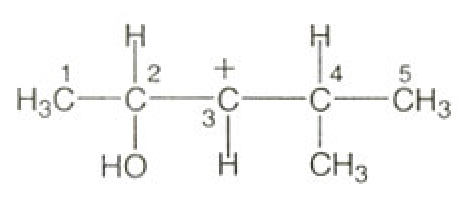
Options
A
at
B
at
C
at
DCorrect
at
Topics & Concepts
Step-by-Step Solution
To determine which group is most likely to migrate to the positively charged carbon (), we evaluate the relative stability of the resulting carbocations formed via 1,2-shifts from the adjacent carbons ( and ):
-
Shift from :
- Hydride () shift from :
Moving the hydride from to produces a tertiary () carbocation at , which is stabilized primarily by hyperconjugation and inductive effects:
- Methyl () shift from :
Hydride shifts have a much higher migratory aptitude than methyl shifts; furthermore, a methyl shift from yields a less stable secondary carbocation.
- Hydride () shift from :
-
Shift from :
- Hydride () shift from :
Moving the hydride from to creates a carbocation directly on :
This carbocation is extraordinarily stable due to the strong resonance donation ( effect) of the lone pair of electrons on the oxygen atom of the group, which allows every atom to attain a complete octet. - Methyl () shift from :
There is no methyl group attached directly to (only , , methyl group, and ). Even considering migratory aptitude, hydride shifts are significantly faster than alkyl shifts ().
- Hydride () shift from :
Since the resonance-stabilized (octet-complete) oxocarbenium ion formed by the 1,2-hydride shift from is far more stable than the carbocation formed by migration from , the migration of at provides the greatest thermodynamic driving force and proceeds with the lowest activation energy.
Therefore, the group that is most likely to migrate is at .
Correct Answer: D