JEE Challenger
More from Thermodynamics

Monatomic Ideal Gas Cycle Analysis on Volume Temperature Diagram

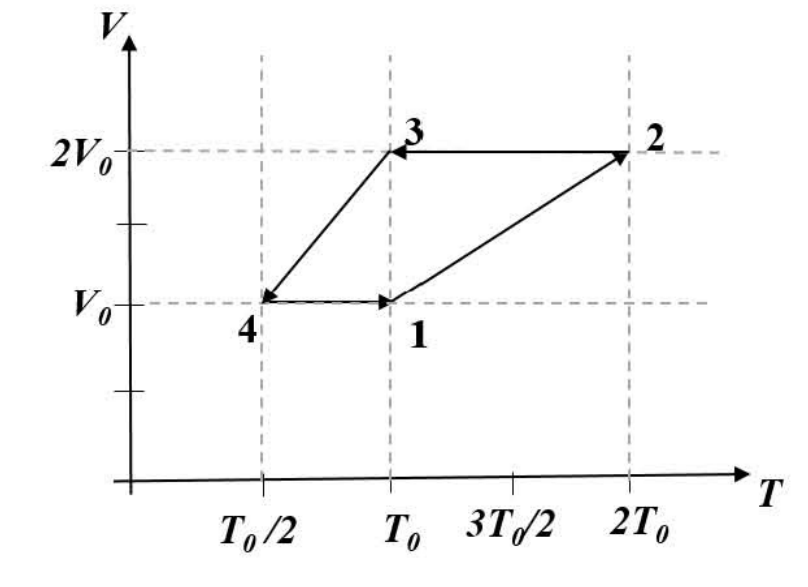
Consider one mole of a monatomic ideal gas undergoing a cyclic thermodynamic process, illustrated in the volume against temperature (VV-TT) plot. Which among the following statements is/are correct? [RR represents the universal gas constant]

Question Diagram 1

Options

A

Work done in this thermodynamic cycle (1→2→3→4→11 \rightarrow 2 \rightarrow 3 \rightarrow 4 \rightarrow 1) is ∣W∣=12RT0|W| = \frac{1}{2} R T_0

Correct
B

The given thermodynamic cycle involves only isochoric and adiabatic processes.

C

The ratio of heat transferred during the processes 1→21 \rightarrow 2 and 2→32 \rightarrow 3 is ∣Q1→2Q2→3∣=53\left| \frac{Q_{1 \rightarrow 2}}{Q_{2 \rightarrow 3}} \right| = \frac{5}{3}

Correct
D

The ratio of heat transferred during the processes 1→21 \rightarrow 2 and 3→43 \rightarrow 4 is ∣Q1→2Q3→4∣=12\left| \frac{Q_{1 \rightarrow 2}}{Q_{3 \rightarrow 4}} \right| = \frac{1}{2}

Step-by-Step Solution

To analyze the given thermodynamic cycle 1→2→3→4→11 \rightarrow 2 \rightarrow 3 \rightarrow 4 \rightarrow 1 for n=1n = 1 mole of a monatomic ideal gas, we identify the nature of each thermodynamic process from the VV-TT diagram:

For a monatomic ideal gas, the molar heat capacities are: CV=32RandCP=52RC_V = \frac{3}{2}R \quad \text{and} \quad C_P = \frac{5}{2}R


Process-by-Process Analysis

  1. Process 1→21 \rightarrow 2:

    • State 1: (T1,V1)=(T0,V0)(T_1, V_1) = (T_0, V_0)
    • State 2: (T2,V2)=(2T0,2V0)(T_2, V_2) = (2T_0, 2V_0)
    • Since the straight line connecting (T0,V0)(T_0, V_0) and (2T0,2V0)(2T_0, 2V_0) passes through the origin, V∝TV \propto T.
    • By the ideal gas equation PV=RTPV = RT, V∝TV \propto T implies the pressure is constant (P1=RT0V0=P0P_1 = \frac{RT_0}{V_0} = P_0). Thus, this is an isobaric expansion.
    • Work done: W1→2=P0(V2−V1)=P0(2V0−V0)=P0V0=RT0W_{1 \rightarrow 2} = P_0 (V_2 - V_1) = P_0 (2V_0 - V_0) = P_0 V_0 = R T_0
    • Heat transferred: Q1→2=nCP(T2−T1)=1⋅(52R)(2T0−T0)=52RT0Q_{1 \rightarrow 2} = n C_P (T_2 - T_1) = 1 \cdot \left(\frac{5}{2}R\right)(2T_0 - T_0) = \frac{5}{2} R T_0
  2. Process 2→32 \rightarrow 3:

    • State 2: (T2,V2)=(2T0,2V0)(T_2, V_2) = (2T_0, 2V_0)
    • State 3: (T3,V3)=(T0,2V0)(T_3, V_3) = (T_0, 2V_0)
    • The volume remains constant at 2V02V_0. Thus, this is an isochoric cooling process.
    • Work done: W2→3=0W_{2 \rightarrow 3} = 0
    • Heat transferred: Q2→3=nCV(T3−T2)=1⋅(32R)(T0−2T0)=−32RT0Q_{2 \rightarrow 3} = n C_V (T_3 - T_2) = 1 \cdot \left(\frac{3}{2}R\right)(T_0 - 2T_0) = -\frac{3}{2} R T_0
  3. Process 3→43 \rightarrow 4:

    • State 3: (T3,V3)=(T0,2V0)(T_3, V_3) = (T_0, 2V_0)
    • State 4: (T4,V4)=(T02,V0)(T_4, V_4) = \left(\frac{T_0}{2}, V_0\right)
    • The line connecting State 3 and State 4 passes through the origin, meaning V∝TV \propto T. Thus, this is an isobaric compression at constant pressure P3=RT02V0=P02P_3 = \frac{R T_0}{2 V_0} = \frac{P_0}{2}.
    • Work done: W3→4=P3(V4−V3)=P02(V0−2V0)=−12P0V0=−12RT0W_{3 \rightarrow 4} = P_3 (V_4 - V_3) = \frac{P_0}{2} (V_0 - 2V_0) = -\frac{1}{2} P_0 V_0 = -\frac{1}{2} R T_0
    • Heat transferred: Q3→4=nCP(T4−T3)=1⋅(52R)(T02−T0)=−54RT0Q_{3 \rightarrow 4} = n C_P (T_4 - T_3) = 1 \cdot \left(\frac{5}{2}R\right)\left(\frac{T_0}{2} - T_0\right) = -\frac{5}{4} R T_0
  4. Process 4→14 \rightarrow 1:

    • State 4: (T4,V4)=(T02,V0)(T_4, V_4) = \left(\frac{T_0}{2}, V_0\right)
    • State 1: (T1,V1)=(T0,V0)(T_1, V_1) = (T_0, V_0)
    • The volume remains constant at V0V_0. Thus, this is an isochoric heating process.
    • Work done: W4→1=0W_{4 \rightarrow 1} = 0

Evaluation of Options

  • Option A: Total work done in the thermodynamic cycle: ∣W∣=∣W1→2+W2→3+W3→4+W4→1∣|W| = |W_{1 \rightarrow 2} + W_{2 \rightarrow 3} + W_{3 \rightarrow 4} + W_{4 \rightarrow 1}| ∣W∣=∣RT0+0−12RT0+0∣=12RT0|W| = \left| R T_0 + 0 - \frac{1}{2} R T_0 + 0 \right| = \frac{1}{2} R T_0 Therefore, Option A is CORRECT.

  • Option B: The cycle consists of two isobaric processes (1→21 \rightarrow 2 and 3→43 \rightarrow 4) and two isochoric processes (2→32 \rightarrow 3 and 4→14 \rightarrow 1), with no adiabatic process involved. Therefore, Option B is INCORRECT.

  • Option C: Ratio of heat transferred during 1→21 \rightarrow 2 and 2→32 \rightarrow 3: ∣Q1→2Q2→3∣=∣52RT0−32RT0∣=53\left| \frac{Q_{1 \rightarrow 2}}{Q_{2 \rightarrow 3}} \right| = \left| \frac{\frac{5}{2} R T_0}{-\frac{3}{2} R T_0} \right| = \frac{5}{3} Therefore, Option C is CORRECT.

  • Option D: Ratio of heat transferred during 1→21 \rightarrow 2 and 3→43 \rightarrow 4: ∣Q1→2Q3→4∣=∣52RT0−54RT0∣=2\left| \frac{Q_{1 \rightarrow 2}}{Q_{3 \rightarrow 4}} \right| = \left| \frac{\frac{5}{2} R T_0}{-\frac{5}{4} R T_0} \right| = 2 Therefore, Option D is INCORRECT.


Conclusion

The correct options are A and C.