Focal Length Variation in Thin Lens Made of Two Refractive Materials
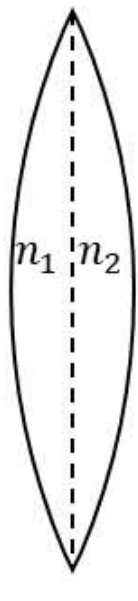
A thin convex lens is constructed from two materials with refractive indices n1 and n2, as illustrated in the figure. The radii of curvature of both spherical surfaces are equal. Let f be the focal length when n1=n2=n. The focal length is f+Δf when n1=n and n2=n+Δn. Assuming Δ n \ll (n - 1) and 1<n<2, which of the following statement(s) is/are correct?
Options
A
fΔf<nΔn
B
For n=1.5, Δn=10−3, and f=20 cm, the magnitude ∣Δf∣ equals 0.02 cm (rounded off to 2nd decimal place).
Correct
C
If nΔn<0, then fΔf>0
Correct
D
The relationship between fΔf and nΔn stays unchanged if both convex surfaces are replaced with concave surfaces of the same radius of curvature.
To determine the correct statements, we analyze the focal length of the thin lens composed of two halves placed together.
1. Derivation of the Focal Length Relation
The lens is split vertically down the middle into two thin plano-convex lenses in contact.
For the left half made of material with refractive index n1:
The radius of the left spherical surface is R1=+R.
The flat surface has R2=∞.
The optical power of the left half is:
P1=(n1−1)(R1−∞1)=Rn1−1
For the right half made of material with refractive index n2:
The flat surface has R1′=∞.
The radius of the right spherical surface is R2′=−R.
The optical power of the right half is:
P2=(n2−1)(∞1−(−R1))=Rn2−1
The total power of the combination is:
P=P1+P2=Rn1+n2−2
Case 1: n1=n2=n
Let f be the focal length in this case:
f1=R2(n−1)⟹R=2(n−1)f
Case 2: n1=n and n2=n+Δn
The new focal length is f+Δf:
f+Δf1=Rn−1+n+Δn−1=R2(n−1)+Δn
Substitute R=2(n−1)f into the equation:
f+Δf1=2(n−1)f2(n−1)+Δn=f1(1+2(n−1)Δn)
Taking the reciprocal using the binomial approximation (1+x)−1≈1−x for x=2(n−1)Δn≪1:
f+Δf≈f(1−2(n−1)Δn)
Δf=−2(n−1)fΔn
Dividing by f, we get the fractional change in focal length:
fΔf=−2(n−1)Δn=−2(n−1)n(nΔn)
2. Evaluation of the Options
Option A:
Taking the absolute value:
fΔf=2(n−1)nnΔn
Given 1<n<2, we have n−2<0⟹2(n−1)<n.
Thus, 2(n−1)n>1, which implies:
fΔf>nΔn
Hence, Option A is incorrect.
Option B:
Given n=1.5, Δn=10−3, and f=20 cm:
∣Δf∣=2(n−1)fΔn=2(1.5−1)20×10−3=120×10−3=0.02 cm
Hence, Option B is correct.
Option C:
Since fΔf=−2(n−1)n(nΔn) and 2(n−1)n>0 for 1<n<2:
If nΔn<0, then fΔf>0.
Hence, Option C is correct.
Option D:
If the convex surfaces are replaced by concave surfaces of radius R:
Power of left half: P1=−Rn1−1
Power of right half: P2=−Rn2−1
Total power: P=−Rn1+n2−2
For n1=n2=n:
f1=−R2(n−1)⟹R=−2(n−1)f
For n1=n and n2=n+Δn:
f+Δf1=−R2(n−1)+Δn=2(n−1)f2(n−1)+Δn=f1(1+2(n−1)Δn)
Applying binomial approximation gives the exact same relation:
fΔf=−2(n−1)Δn
Hence, Option D is correct.