Maximum Time Taken by Light Ray Traversing Optical Slab via Total Internal Reflection
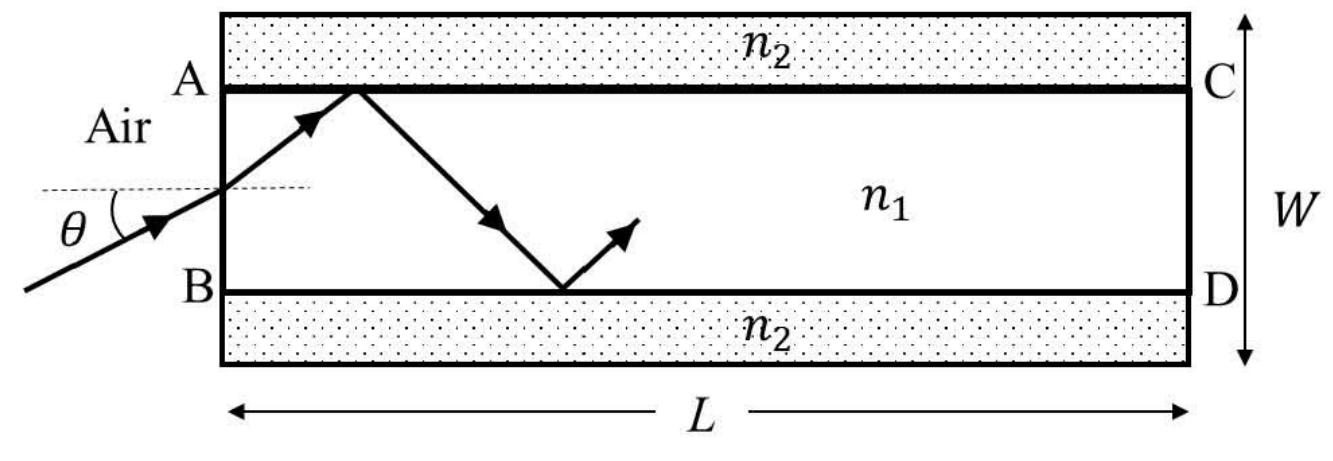
A planar structure of length and width is constructed from two distinct optical media having refractive indices and , as depicted in the diagram. Given that , a light ray entering from edge AB emerges from edge CD provided the condition for total internal reflection is satisfied inside the structure. For , as the angle of incidence is varied, the maximum duration taken by a ray to exit the boundary CD is . Find the value of . [Speed of light ]
Topics & Concepts
Step-by-Step Solution
To find the maximum time taken by a light ray to exit from the edge , we need to analyze the trajectory of the ray inside the medium of refractive index .
-
Geometry and Refraction at the Entrance Face (AB): Let be the angle of incidence in air at the face , and be the angle of refraction inside the medium measured relative to the normal to (which is parallel to the length of the structure).
By Snell's law at the entrance face :
-
Total Internal Reflection (TIR) Condition at the Interface: The angle of incidence of the ray at the boundary is . For Total Internal Reflection to occur at this boundary:
Substituting the given refractive indices and :
(Note: Since , the required angle is achievable via refraction since .)
-
Time Taken to Cross the Slab: The total path length traveled by the ray inside medium to cover a horizontal distance is:
The speed of light in medium is:
Therefore, the time taken by the ray to exit the boundary is:
-
Maximum Time Calculation: To maximize the time , the term must take its minimum permissible value while still satisfying the TIR condition:
Substituting into the time expression gives:
Plugging in the given values (, , , and ):
Thus, the value of is 50.