Maximum Number of Monochlorination Isomers for Branched Alkane
The maximum number of isomers (including stereoisomers) that are possible on monochlorination of the following compound, is
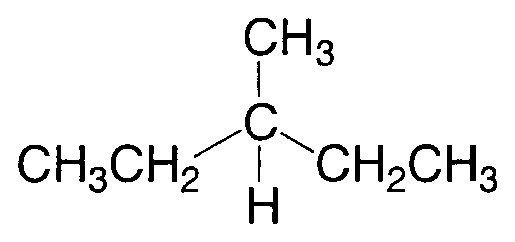
Step-by-Step Solution
To find the maximum number of isomers (including stereoisomers) formed by the monochlorination of 3-methylpentane, we analyze the different positions at which a hydrogen atom can be replaced by a chlorine atom ().
The structure of the given compound is 3-methylpentane:
Due to the symmetry of the molecule, there are four distinct types of hydrogen atoms that can be substituted:
1. Chlorination at the methyl group attached to C-3
Replacing a hydrogen on the branch methyl group yields:
- The central carbon (C-3) is bonded to:
- Two identical ethyl groups ()
- Since it has two identical groups, this molecule is achiral and has no stereocenters.
- Number of isomers =
2. Chlorination at the C-3 tertiary carbon
Replacing the tertiary hydrogen at C-3 yields:
- The central carbon (C-3) is bonded to:
- Two identical ethyl groups ()
- Due to the presence of two identical ethyl groups, this molecule is also achiral and optically inactive.
- Number of isomers =
3. Chlorination at C-2 (or the equivalent C-4 position)
Replacing a hydrogen at the secondary carbon C-2 yields:
- C-2 is bonded to four different groups: , , , and (chiral center).
- C-3 is bonded to four different groups: , , , and (chiral center).
- Since both C-2 and C-3 are distinct chiral centers and the molecule is not symmetrical, the total number of stereoisomers is:
- Number of isomers =
4. Chlorination at C-1 (or the equivalent C-5 position)
Replacing a hydrogen at the terminal methyl carbon C-1 yields:
- C-3 is bonded to four different groups:
- (ethyl group)
- (2-chloroethyl group)
- Since all four groups on C-3 are distinct, C-3 is a chiral center.
- This compound exists as a pair of enantiomers ( and ).
- Number of isomers =
Total Number of Isomers:
Thus, the maximum number of isomers (including stereoisomers) is 8.