Matching Reactions with Intermediate and Final Products for Substrates Three and Four
Comprehension Passage
Answer Q.17 and Q.18 by appropriately matching the lists based on the information given in the paragraph.
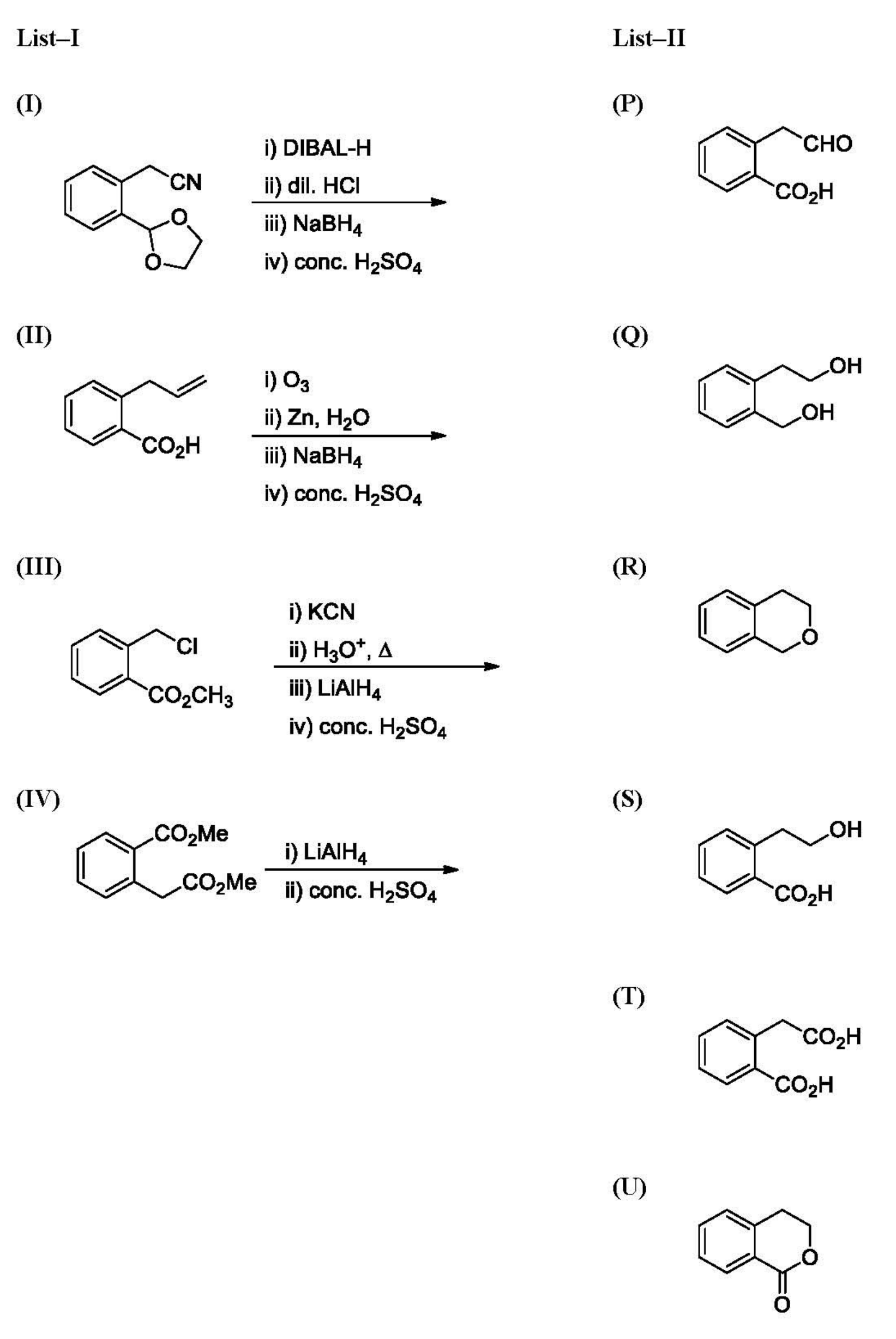
List-I includes starting materials and reagents of selected chemical reactions. List-II gives structures of compounds that may be formed as intermediate products and/or final products from the reactions of List-I.
Which of the following options represents the correct combination considering List-I and List-II?
Options
A
(III), (S), (R)
B
(IV), (Q), (U)
C
(III), (T), (U)
DCorrect
(IV), (Q), (R)
Step-by-Step Solution
To determine the correct combination for Question 18, let us analyze the reactions given in List-I for substrates (III) and (IV):
Analysis of Reaction (III):
- Starting Material: Methyl 2-(chloromethyl)benzoate, .
- Step (i) & (ii):
- Reaction with substitutes the chlorine atom via an mechanism to yield the nitrile: .
- Acidic hydrolysis () hydrolyzes the group to and the ester group to .
- This yields 2-(carboxymethyl)benzoic acid (T).
- Step (iii):
- Reduction with reduces both carboxylic acid groups:
- Step (iv):
- Intramolecular acid-catalyzed dehydration of the diol with concentrated forms the 6-membered cyclic ether isochroman (R).
Intermediates and final products for (III): , , .
Analysis of Reaction (IV):
- Starting Material: Methyl 2-(2-methoxy-2-oxoethyl)benzoate, .
- Step (i):
- Reduction with converts both ester groups into alcohols:
- This forms the diol intermediate 2-(2-hydroxyethyl)benzyl alcohol (Q).
- Reduction with converts both ester groups into alcohols:
- Step (ii):
- Treatment of diol (Q) with concentrated causes intramolecular dehydration to yield the cyclic ether isochroman (R) as the final product.
Intermediates and final products for (IV): and .
Matching with the Options:
- (A) (III), (S), (R) Incorrect
- (B) (IV), (Q), (U) Incorrect
- (C) (III), (T), (U) Incorrect
- (D) (IV), (Q), (R) Correct
Correct Answer: D