Matching Reactions with Intermediate and Final Products for Substrates One and Two
Answer Q.17 and Q.18 by appropriately matching the lists based on the information given in the paragraph.
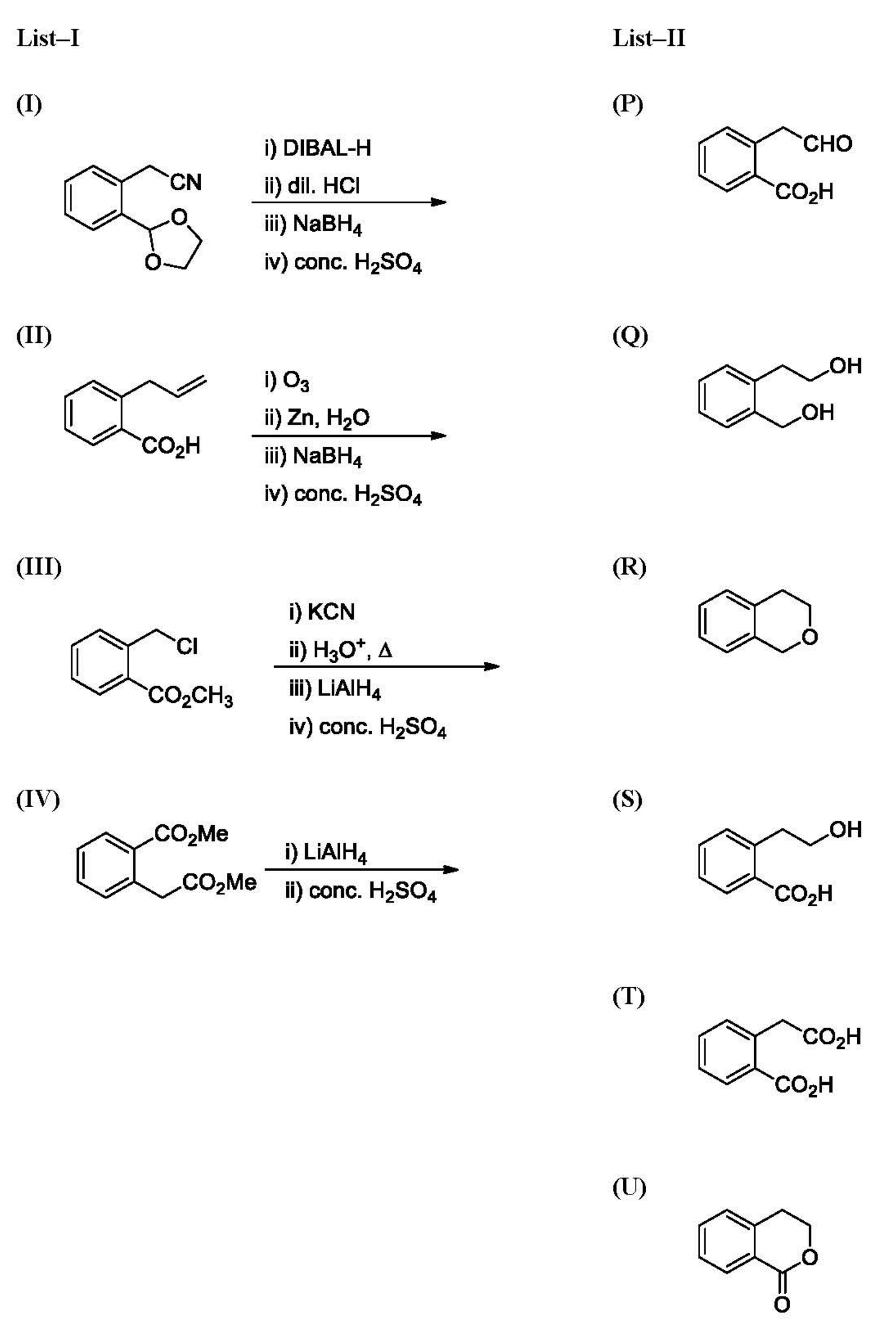
List-I includes starting materials and reagents of selected chemical reactions. List-II gives structures of compounds that may be formed as intermediate products and/or final products from the reactions of List-I.
Which of the following options represents the correct combination considering List-I and List-II?
Options
(I), (Q), (T), (U)
(II), (P), (S), (T)
(II), (P), (S), (U)
(I), (S), (Q), (R)
Step-by-Step Solution
To determine the correct combination of starting materials, reagents, intermediates, and final products, let us analyze Reaction (II) step-by-step:
-
Substrate in Reaction (II): The starting material is 2-allylbenzoic acid, which contains an allyl group () and a carboxylic acid group () in ortho-positions on a benzene ring.
-
Step (i) & (ii) - Ozonolysis with reductive workup (, followed by ):
- The terminal alkene group of the allyl substituent undergoes oxidative cleavage to yield an aldehyde group:
- The carboxylic acid group remains unchanged.
- This forms 2-(2-oxoethyl)benzoic acid, which corresponds to compound (P).
-
Step (iii) - Reduction with :
- Sodium borohydride selectively reduces the aldehyde group to a primary alcohol while leaving the carboxylic acid group unaffected:
- This produces 2-(2-hydroxyethyl)benzoic acid, which corresponds to compound (S).
-
Step (iv) - Acid-catalyzed lactonization ():
- In the presence of concentrated , an intramolecular esterification (lactonization) occurs between the carboxylic acid () and the alcohol () groups to form a stable 6-membered lactone (isochroman-1-one):
- This gives the final product, which corresponds to compound (U).
Hence, the complete pathway for (II) involves the intermediates and product (P), (S), and (U).
Therefore, the correct combination is (II), (P), (S), (U).
Correct Option: C