Matching Aromatic Precursors with Multi Step Synthesis Schemes
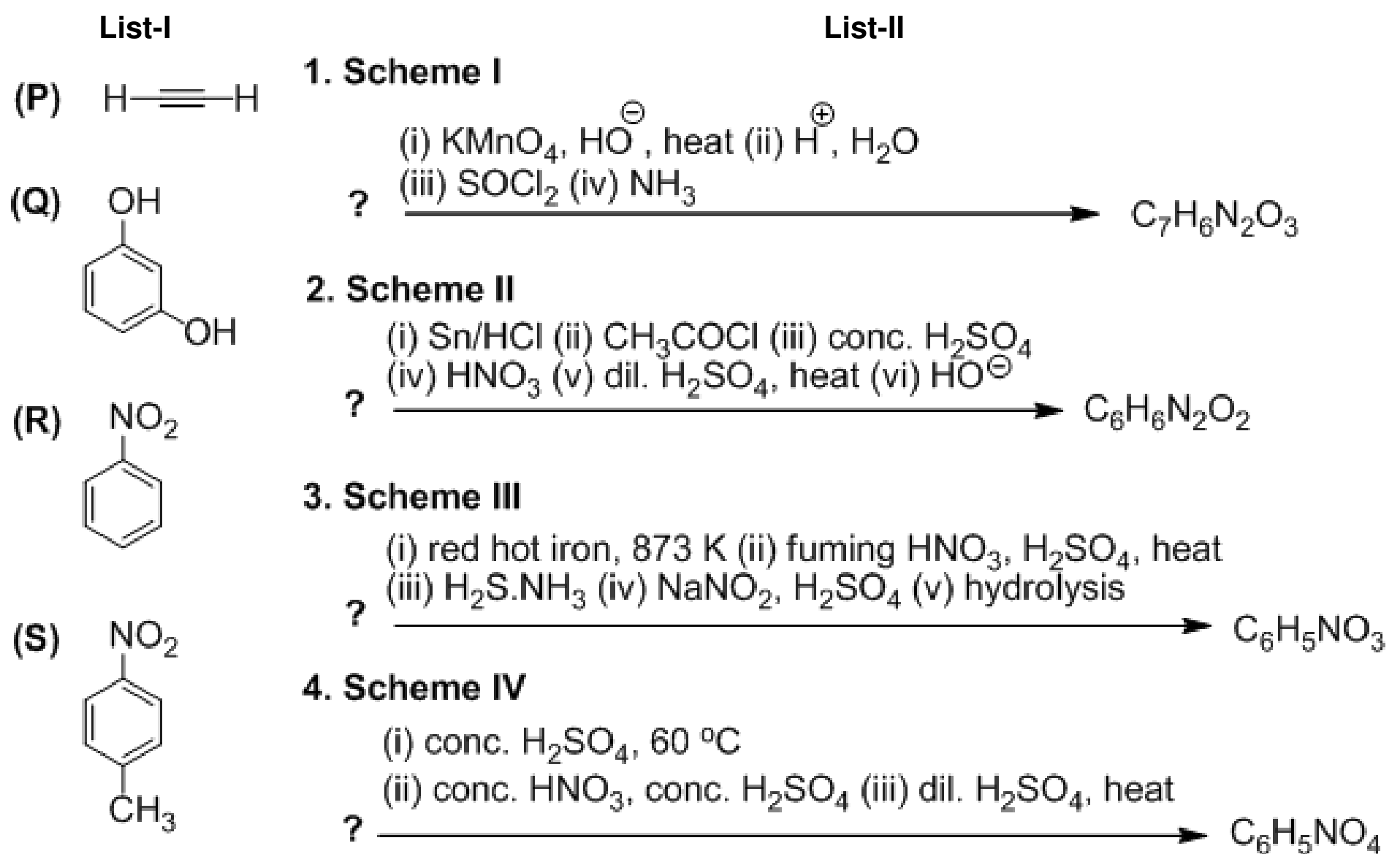
Match the four starting substrates (P, Q, R, S) given in List I with the appropriate multi-step reaction sequences (1, 2, 3, 4) provided in List II and select the correct matching code:
To determine the correct match between the starting materials in List-I and the reaction sequences in List-II, let us analyze each scheme:
1. Analysis of Substrate P (Ethyne, HC≡CH):
Scheme III starts with:
HC≡CHred hot Fe, 873 KBenzene (C6H6)
Benzene undergoes dinitration with fuming HNO3/H2SO4 under heating to give 1,3-dinitrobenzene:
C6H6fuming HNO3,H2SO4,Δ1,3-dinitrobenzene
Selective reduction of one nitro group using H2S⋅NH3 (Zinin reduction) yields 3-nitroaniline:
1,3-dinitrobenzeneH2S⋅NH33-nitroaniline
Diazotization of the amino group followed by hydrolysis gives 3-nitrophenol:
3-nitroanilineNaNO2H2SO4diazonium salthydrolysis3-nitrophenol (C6H5NO3)
The molecular formula matches: C6H5NO3.
Therefore, P→3.
2. Analysis of Substrate Q (Resorcinol, benzene-1,3-diol):
Scheme IV:
Resorcinol undergoes disulfonation at 60∘C to yield 4,6-disulfonic acid derivative of resorcinol:
Resorcinolconc. H2SO4,60∘C4,6-disulforesorcinol
The sulfonic acid groups at positions 4 and 6 block these activated positions, directing nitration to position 2:
4,6-disulforesorcinolconc. HNO3,H2SO42-nitrobenzene-1,3-diol-4,6-disulfonic acid
Desulfonation using dilute H2SO4 and heat removes the −SO3H groups:
dil. H2SO4,Δ2-nitroresorcinol (C6H5NO4)
The molecular formula matches: C6H5NO4.
Therefore, Q→4.
3. Analysis of Substrate R (Nitrobenzene, C6H5NO2):
Scheme II:
Reduction with Sn/HCl gives aniline:
C6H5NO2Sn/HClC6H5NH2
Protection of the −NH2 group with CH3COCl gives acetanilide:
C6H5NH2CH3COClC6H5NHCOCH3
Sulfonation with concentrated H2SO4 directs mainly to the para-position:
C6H5NHCOCH3conc. H2SO44-acetamidobenzenesulfonic acid
Nitration with HNO3 occurs ortho to the −NHCOCH3 group (position 2):
HNO34-acetamido-3-nitrobenzenesulfonic acid
Heating with dilute H2SO4 causes desulfonation:
dil. H2SO4,Δ2-nitroacetanilide
Basic hydrolysis removes the acetyl protecting group to yield 2-nitroaniline:
HO−2-nitroaniline (C6H6N2O2)
The molecular formula matches: C6H6N2O2.
Therefore, R→2.
4. Analysis of Substrate S (4-Nitrotoluene, O2N−C6H4−CH3):
Scheme I:
Oxidation of the benzylic methyl group of 4-nitrotoluene with alkaline KMnO4 followed by acidification:
4-nitrotoluene(i) KMnO4,HO−,Δ(ii) H+,H2O4-nitrobenzoic acid
Reaction with SOCl2 converts the carboxylic acid into an acyl chloride:
4-nitrobenzoic acidSOCl24-nitrobenzoyl chloride
Reaction with NH3 yields 4-nitrobenzamide:
4-nitrobenzoyl chlorideNH34-nitrobenzamide (C7H6N2O3)