JEE Challenger
More from Aldehydes, Ketones and Carboxylic Acids

Match Peroxyester Thermal Decomposition Pathways to Molecular Structures

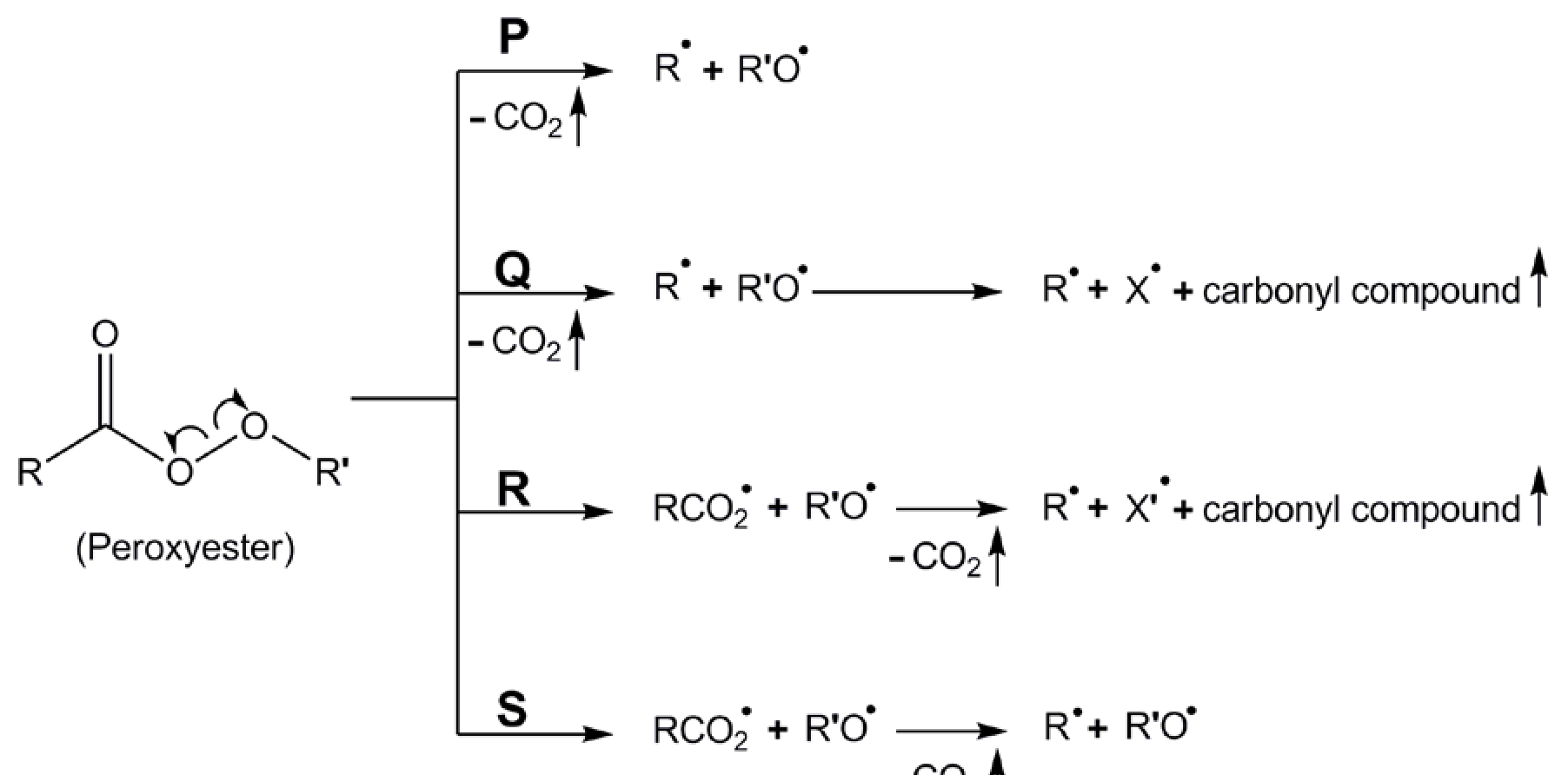
Various feasible thermal decomposition pathways for peroxyesters are illustrated below. Match each pathway presented in List I with the corresponding structure in List II and choose the correct code from the options given.

List-I P. Pathway P
Q. Pathway Q
R. Pathway R
S. Pathway S

List-II
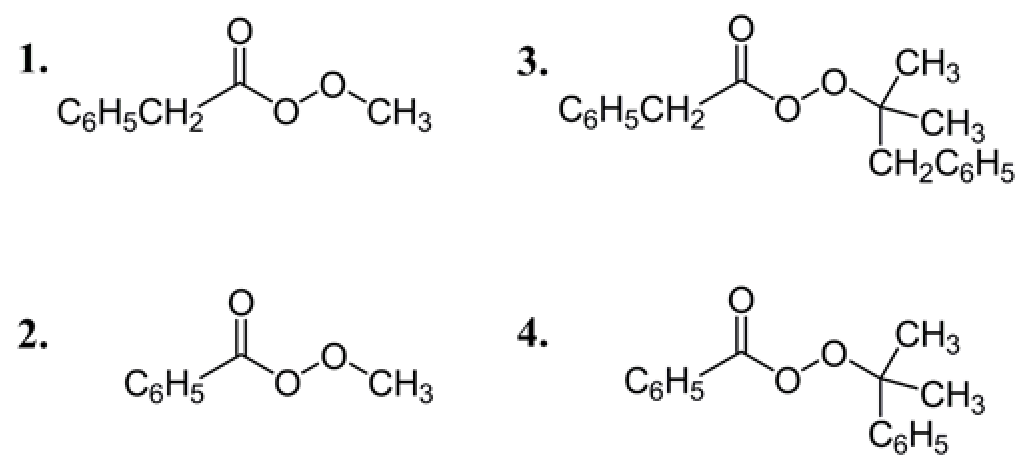
(Refer to structures 1, 2, 3, and 4 in the diagram)
Question Diagram 1
Question Diagram 2

Options

A

P →\rightarrow 1, Q →\rightarrow 3, R →\rightarrow 4, S →\rightarrow 2

Correct
B

P →\rightarrow 2, Q →\rightarrow 4, R →\rightarrow 3, S →\rightarrow 1

C

P →\rightarrow 4, Q →\rightarrow 1, R →\rightarrow 2, S →\rightarrow 3

D

P →\rightarrow 3, Q →\rightarrow 2, R →\rightarrow 1, S →\rightarrow 4

Step-by-Step Solution

To determine the correct thermal decomposition pathway for each peroxyester, we analyze the mechanism of homolytic cleavage and subsequent radical reactions:

  1. Nature of the First Cleavage Step (One-bond vs. Two-bond Cleavage):

    • When R=C6H5CH2\text{R} = \text{C}_6\text{H}_5\text{CH}_2 (benzyl), the resulting benzyl radical C6H5CH2∙\text{C}_6\text{H}_5\text{CH}_2^\bullet is highly resonance-stabilized. This stability promotes a concerted two-bond homolytic cleavage involving the simultaneous rupture of the O−O\text{O}-\text{O} bond and the R−C\text{R}-\text{C} bond, leading directly to the extrusion of CO2\text{CO}_2 in the initial step: R−C(=O)−O−O−R′→−CO2R∙+R′O∙\text{R}-\text{C}(=\text{O})-\text{O}-\text{O}-\text{R}' \xrightarrow{-\text{CO}_2} \text{R}^\bullet + \text{R}'\text{O}^\bullet This corresponds to Pathways P and Q.
    • When R=C6H5\text{R} = \text{C}_6\text{H}_5 (phenyl), the phenyl radical is significantly less stable, and concerted cleavage is energetically unfavorable. Therefore, it undergoes a stepwise single-bond cleavage of the weak O−O\text{O}-\text{O} bond first to form an aroyloxy radical and an alkoxy radical: R−C(=O)−O−O−R′⟶RCO2∙+R′O∙\text{R}-\text{C}(=\text{O})-\text{O}-\text{O}-\text{R}' \longrightarrow \text{RCO}_2^\bullet + \text{R}'\text{O}^\bullet Subsequent loss of CO2\text{CO}_2 occurs in a later step: RCO2∙→−CO2R∙\text{RCO}_2^\bullet \xrightarrow{-\text{CO}_2} \text{R}^\bullet This corresponds to Pathways R and S.
  2. Fate of the Alkoxy Radical (R′O∙\text{R}'\text{O}^\bullet):

    • When R′=−CH3\text{R}' = -\text{CH}_3 (Structures 1 and 2), the methoxy radical CH3O∙\text{CH}_3\text{O}^\bullet does not undergo β\beta-scission because the expulsion of a hydrogen atom (H∙\text{H}^\bullet) is thermodynamically unfavorable. Hence, no carbonyl compound is produced.
    • When R′\text{R}' is a tertiary alkyl group (Structures 3 and 4), the alkoxy radical undergoes facile β\beta-scission (fragmentation) to yield a stable radical X∙\text{X}^\bullet and a carbonyl compound:
      • For Structure 3 (R′=−C(CH3)2CH2C6H5\text{R}' = -\text{C}(\text{CH}_3)_2\text{CH}_2\text{C}_6\text{H}_5): C6H5CH2C(CH3)2O∙⟶CH3COCH3+C6H5CH2∙ (X∙)\text{C}_6\text{H}_5\text{CH}_2\text{C}(\text{CH}_3)_2\text{O}^\bullet \longrightarrow \text{CH}_3\text{COCH}_3 + \text{C}_6\text{H}_5\text{CH}_2^\bullet \, (\text{X}^\bullet)
      • For Structure 4 (R′=−C(CH3)2C6H5\text{R}' = -\text{C}(\text{CH}_3)_2\text{C}_6\text{H}_5): C6H5C(CH3)2O∙⟶C6H5COCH3+CH3∙ (X∙)\text{C}_6\text{H}_5\text{C}(\text{CH}_3)_2\text{O}^\bullet \longrightarrow \text{C}_6\text{H}_5\text{COCH}_3 + \text{CH}_3^\bullet \, (\text{X}^\bullet)
  3. Matching the Pathways:

    • Pathway P: Direct CO2\text{CO}_2 extrusion without β\beta-scission   ⟹  \implies Structure 1 (R=C6H5CH2, R′=CH3\text{R} = \text{C}_6\text{H}_5\text{CH}_2, \, \text{R}' = \text{CH}_3).
    • Pathway Q: Direct CO2\text{CO}_2 extrusion followed by β\beta-scission to form a carbonyl compound   ⟹  \implies Structure 3 (R=C6H5CH2, R′=−C(CH3)2CH2C6H5\text{R} = \text{C}_6\text{H}_5\text{CH}_2, \, \text{R}' = -\text{C}(\text{CH}_3)_2\text{CH}_2\text{C}_6\text{H}_5).
    • Pathway R: Stepwise CO2\text{CO}_2 loss accompanied by β\beta-scission to form a carbonyl compound   ⟹  \implies Structure 4 (R=C6H5, R′=−C(CH3)2C6H5\text{R} = \text{C}_6\text{H}_5, \, \text{R}' = -\text{C}(\text{CH}_3)_2\text{C}_6\text{H}_5).
    • Pathway S: Stepwise CO2\text{CO}_2 loss without β\beta-scission   ⟹  \implies Structure 2 (R=C6H5, R′=CH3\text{R} = \text{C}_6\text{H}_5, \, \text{R}' = \text{CH}_3).

Therefore, the correct matching is: P→1,Q→3,R→4,S→2\text{P} \rightarrow 1, \quad \text{Q} \rightarrow 3, \quad \text{R} \rightarrow 4, \quad \text{S} \rightarrow 2

This corresponds to option (A).