To determine the correct match between Column I and Column II, we analyze each thermodynamic process for one mole (n=1) of a monatomic ideal gas (CV=23R, CP=25R).
The internal energy of a monatomic ideal gas at any state (P,V) is given by:
U=nCVT=23PV
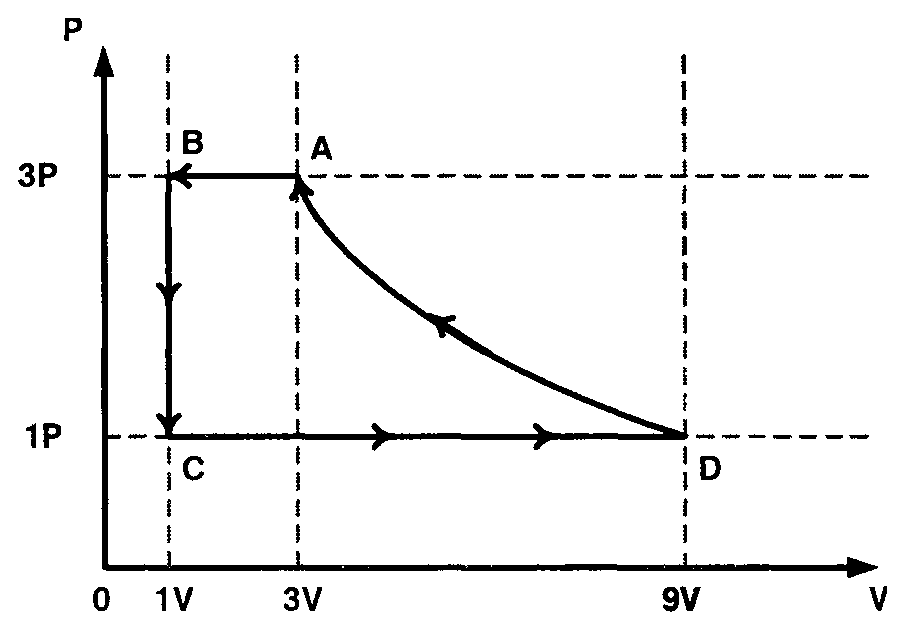
From the given P-V diagram, the state variables (P,V) and internal energies at the four vertices are:
- State A: PA=3P, VA=3V⟹UA=23(3P)(3V)=227PV
- State B: PB=3P, VB=1V⟹UB=23(3P)(1V)=29PV
- State C: PC=1P, VC=1V⟹UC=23(1P)(1V)=23PV
- State D: PD=1P, VD=9V⟹UD=23(1P)(9V)=227PV
Analysis of Processes:
(A) Process A→B (Isobaric Compression):
-
Internal Energy Change:
ΔUAB=UB−UA=29PV−227PV=−9PV<0
Since ΔU<0, internal energy decreases (p).
-
Work Done:
WAB=PA(VB−VA)=3P(1V−3V)=−6PV<0
Since W<0, work is done on the gas (t).
-
Heat Exchange:
QAB=ΔUAB+WAB=−9PV−6PV=−15PV<0
Since Q<0, heat is lost (r).
Thus, (A) matches with (p), (r), (t).
(B) Process B→C (Isochoric Cooling):
-
Internal Energy Change:
ΔUBC=UC−UB=23PV−29PV=−3PV<0
Since ΔU<0, internal energy decreases (p).
-
Work Done:
WBC=0(since volume is constant)
-
Heat Exchange:
QBC=ΔUBC+WBC=−3PV+0=−3PV<0
Since Q<0, heat is lost (r).
Thus, (B) matches with (p), (r).
(C) Process C→D (Isobaric Expansion):
-
Internal Energy Change:
ΔUCD=UD−UC=227PV−23PV=12PV>0
Since ΔU>0, internal energy increases (q).
-
Work Done:
WCD=PC(VD−VC)=1P(9V−1V)=8PV>0
Work is done by the gas.
-
Heat Exchange:
QCD=ΔUCD+WCD=12PV+8PV=20PV>0
Since Q>0, heat is gained (s).
Thus, (C) matches with (q), (s).
(D) Process D→A (Isothermal Compression along PV=constant):
-
Internal Energy Change:
Since PDVD=PAVA=9PV, the temperatures at D and A are equal (TD=TA).
ΔUDA=UA−UD=0
-
Work Done:
WDA=nRTln(VDVA)=(9PV)ln(9V3V)=−9PVln(3)<0
Since W<0, work is done on the gas (t).
-
Heat Exchange:
QDA=ΔUDA+WDA=0−9PVln(3)<0
Since Q<0, heat is lost (r).
Thus, (D) matches with (r), (t).
Final Answer:
- (A) → p, r, t
- (B) → p, r
- (C) → q, s
- (D) → r, t