Match Quantum Numbers and Orbitals for Hydrogen Like Species
Answer Q.31, Q.32 and Q.33 by appropriately matching the information provided in the three columns of the table below.
The wave function, , is a mathematical expression depending upon spherical polar coordinates of the electron, characterized by quantum numbers , , and . Here denotes the radial distance from the nucleus, represents colatitude, and is the azimuth. In the given formulas, represents the atomic number and is the Bohr radius.
For the specified orbital in Column 1, identify the only CORRECT combination valid for any hydrogen-like species:
Options
(I) (ii) (S)
(IV) (iv) (R)
(II) (ii) (P)
(III) (iii) (P)
Topics & Concepts
Step-by-Step Solution
To determine the correct combination for Question 31, let me analyze each of the given options step-by-step:
-
Option (A): (I) (ii) (S)
- Column 1 (I) corresponds to the 1s orbital ().
- Column 2 (ii) states "One radial node".
- The number of radial nodes for an orbital is calculated using the formula:
- For a 1s orbital:
- Since the 1s orbital has radial nodes, statement (ii) is incorrect for (I). Thus, Option A is incorrect.
-
Option (B): (IV) (iv) (R)
- Column 1 (IV) corresponds to the orbital.
- Column 2 (iv) states "-plane is a nodal plane".
- The orbital has two conical nodal surfaces centered along the z-axis, not nodal planes. The -plane is a nodal plane for orbitals like or , but not for . Thus, Option B is incorrect.
-
Option (C): (II) (ii) (P)
- Column 1 (II) corresponds to the 2s orbital ().
- Column 2 (ii) states "One radial node". This is correct.
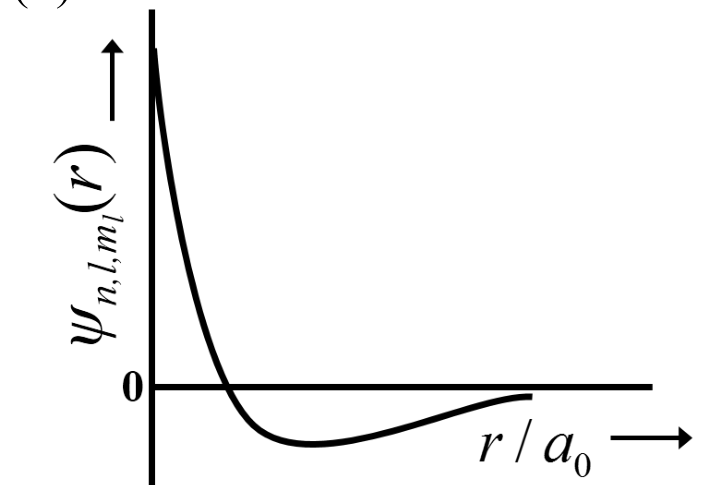
- Column 3 (P) shows the plot of the wave function vs .
- The radial wave function for a 2s orbital is proportional to: At , . As increases, decreases, crosses zero at (representing 1 radial node), becomes negative, reaches a local minimum, and then asymptotically approaches zero as . This precisely matches graph (P).
- Therefore, the combination (II) (ii) (P) is correct.
-
Option (D): (III) (iii) (P)
- Column 1 (III) corresponds to the orbital ().
- For any orbital with angular momentum quantum number (such as orbitals), the wave function value at the nucleus () is zero ().
- Graph (P) shows a non-zero positive value of the wave function at , which is characteristic of an orbital (). Thus, graph (P) does not represent a orbital. Option D is incorrect.
Conclusion: The only correct combination valid for any hydrogen-like species is (C) (II) (ii) (P).