Count of Aromatic Molecules Among Given Structures
Determine the total number of aromatic compounds among the structures shown below:
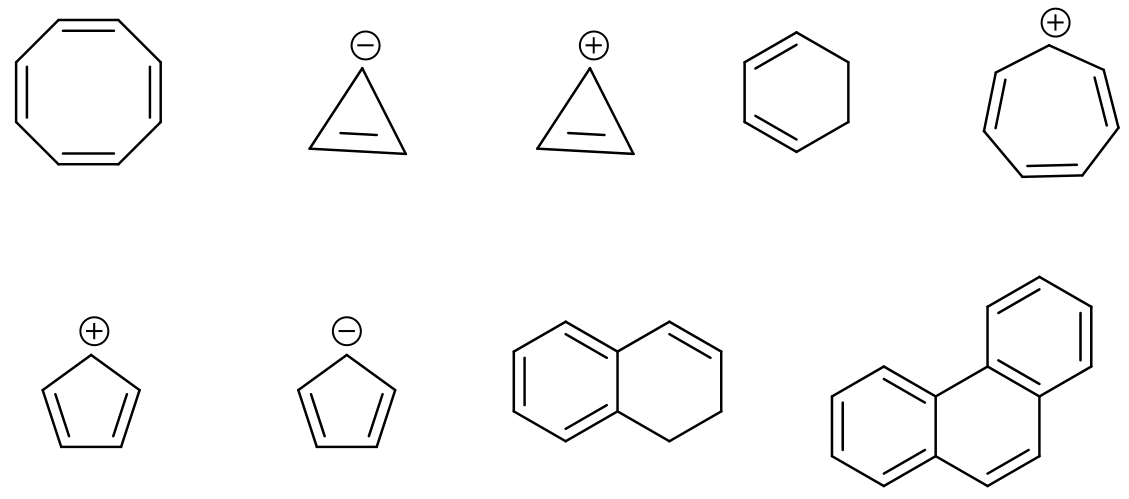
Official Numerical Answer5
Topics & Concepts
Step-by-Step Solution
To determine the total number of aromatic compounds among the given structures, we apply Hückel's Rule for aromaticity. A compound is classified as aromatic if:
- It is cyclic.
- It is planar (or nearly planar) allowing continuous overlap of -orbitals.
- It has a completely conjugated -electron system.
- It contains -electrons, where
Additionally, any compound containing an aromatic moiety (such as a benzene ring) is classified as an aromatic compound.
Detailed Analysis of Each Structure:
-
Cyclooctatetraene ():
- It possesses electrons ( electrons for ).
- To avoid the instability of being antiaromatic, it adopts a non-planar (tub-shaped) conformation.
- Classification: Non-aromatic
-
Cyclopropenyl anion ():
- Contains electrons ( from the double bond + from the negative charge).
- It is planar and fully conjugated, conforming to the rule ().
- Classification: Antiaromatic
-
Cyclopropenyl cation ():
- Contains electrons.
- Follows Hückel's rule for : electrons.
- It is cyclic, planar, and fully conjugated.
- Classification: Aromatic
-
1,3-Cyclohexadiene:
- Contains two -hybridized carbon atoms in the ring, interrupting continuous conjugation around the cycle.
- Classification: Non-aromatic
-
Cycloheptatrienyl cation (Tropylium cation, ):
- Contains electrons across 7 -hybridized carbon atoms.
- Follows Hückel's rule for : electrons.
- It is cyclic, planar, and fully conjugated.
- Classification: Aromatic
-
Cyclopentadienyl cation ():
- Contains electrons in a planar, fully conjugated ring.
- Follows the rule ().
- Classification: Antiaromatic
-
Cyclopentadienyl anion ():
- Contains electrons ( from double bonds + from the lone pair/negative charge).
- Follows Hückel's rule for : electrons.
- It is cyclic, planar, and fully conjugated.
- Classification: Aromatic
-
1,2-Dihydronaphthalene:
- Consists of a benzene ring fused to a partially unsaturated 6-membered ring.
- Since it contains a intact -electron benzene ring system, the molecule is a benzenoid aromatic compound.
- Classification: Aromatic
-
Phenanthrene ():
- Consists of three fused benzene rings with a completely conjugated system containing electrons.
- Follows Hückel's rule for : electrons.
- Classification: Aromatic
Conclusion:
The aromatic compounds among the given structures are:
- Cyclopropenyl cation
- Cycloheptatrienyl cation
- Cyclopentadienyl anion
- 1,2-Dihydronaphthalene
- Phenanthrene
The total number of aromatic compounds is 5.