Major Product of Diazotization and Intramolecular Coupling
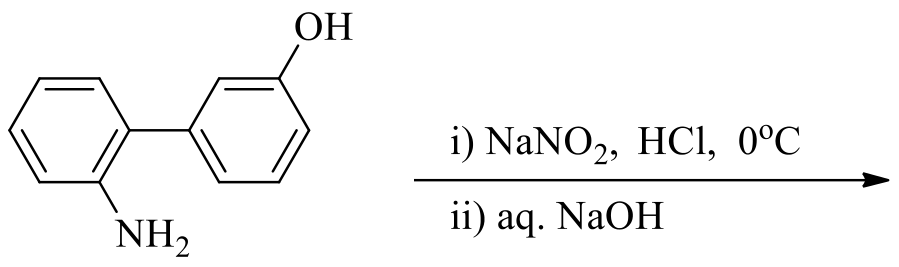
Predict the primary reaction product for the transformation shown below:
Options
Topics & Concepts
Step-by-Step Solution
To determine the major product of the given reaction sequence, let us break down the reaction step-by-step:
Step 1: Diazotization
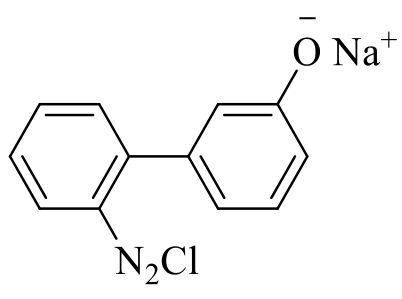
When 2-amino-3'-hydroxybiphenyl is treated with sodium nitrite () and hydrochloric acid () at , the primary aromatic amine () group undergoes diazotization to form an aromatic diazonium salt:
Step 2: Deprotonation in Alkaline Medium
Treatment with aqueous sodium hydroxide () deprotonates the phenolic hydroxyl group () on the second ring to form a phenoxide ion (). The phenoxide ion is a strongly activating group that directs electrophilic aromatic substitution () primarily to the para-position (and secondarily to the ortho-position).
Step 3: Intramolecular Azo Coupling
The diazonium cation () serves as a weak electrophile and undergoes an intramolecular azo coupling with the activated phenoxide ring:
- Regioselectivity: The attack occurs preferentially at position of the second ring, which is para to the phenoxide group (located at position ) and ortho to the inter-ring single bond.
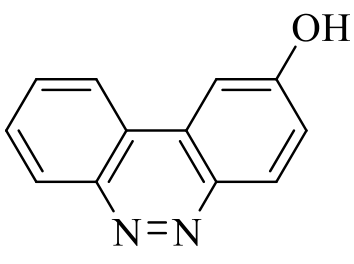
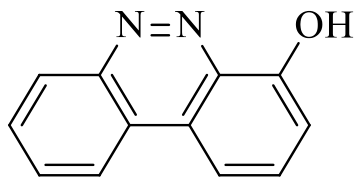
- Ring Stability: Coupling at position leads to the formation of a stable, planar, conjugated 6-membered azo ring (a derivative of benzo[]cinnoline).
Since the phenoxide group () is located para to the site of coupling (position ), protonation during workup yields the 6-membered fused heterocyclic compound with the hydroxyl group () at the position para to the newly formed bond.
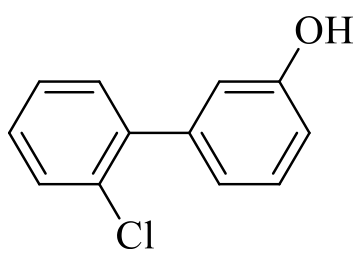
This matches the structure shown in Option [C].
Correct Answer: [C]