Major Product of Aldol and Cannizzaro Reaction Sequence
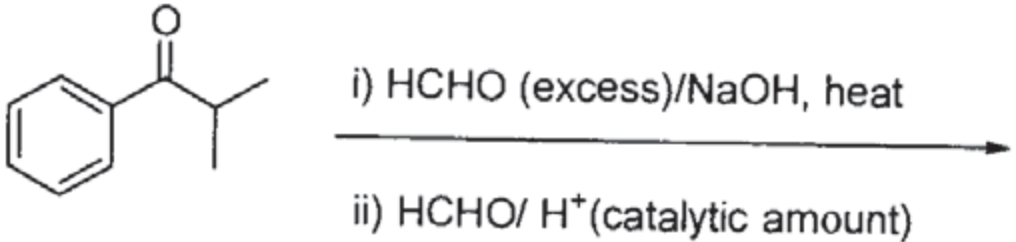
Identify the primary organic compound obtained from the given multi-step reaction scheme starting with the substituted ketone:
Options
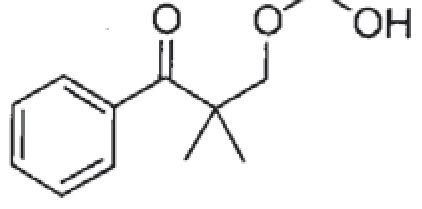
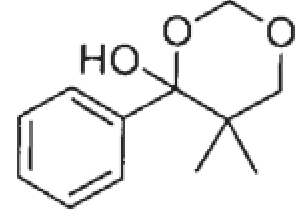
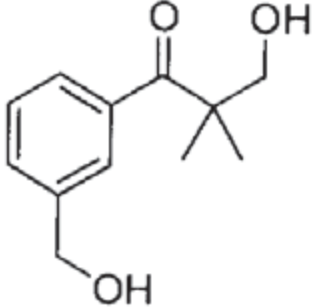
Step-by-Step Solution
To determine the major product of the multi-step reaction sequence, we analyze each step sequentially:
Step 1: Aldol Condensation and Crossed Cannizzaro Reaction
-
Aldol Addition: Isobutyrophenone, , contains a single acidic -hydrogen. In the presence of sodium hydroxide (), deprotonation occurs at the -carbon to form an enolate ion:
The nucleophilic enolate attacks the carbonyl carbon of formaldehyde () to yield a -hydroxy ketone:
-
Crossed Cannizzaro Reaction: Since formaldehyde is in excess and the reaction mixture is heated with strong base (), the newly formed -hydroxy ketone undergoes a crossed Cannizzaro reaction.
Formaldehyde acts as a stronger hydride donor. Attack of on formaldehyde forms a monoanionic intermediate that transfers a hydride ion () to the carbonyl carbon of the -hydroxy ketone, reducing it to a secondary alcohol group:
The resulting product after workup is the 1,3-diol: 2,2-dimethyl-1-phenylpropane-1,3-diol.
Step 2: Cyclic Acetal Formation (Acetalization)
When the 1,3-diol, , is treated with formaldehyde () in the presence of an acid catalyst (), an acetalization reaction takes place.
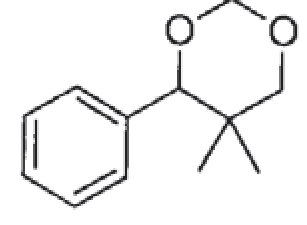
The two hydroxyl () groups of the 1,3-diol condense with the carbonyl carbon of formaldehyde, eliminating one molecule of water () to form a stable 6-membered cyclic acetal (5,5-dimethyl-4-phenyl-1,3-dioxane):
This structure corresponds to Option (A).
Final Answer:
The correct option is (A).