Acidity Order of Substituted Benzoic Acid Derivatives
Select the correct sequence of decreasing acidity among the provided chemical species:
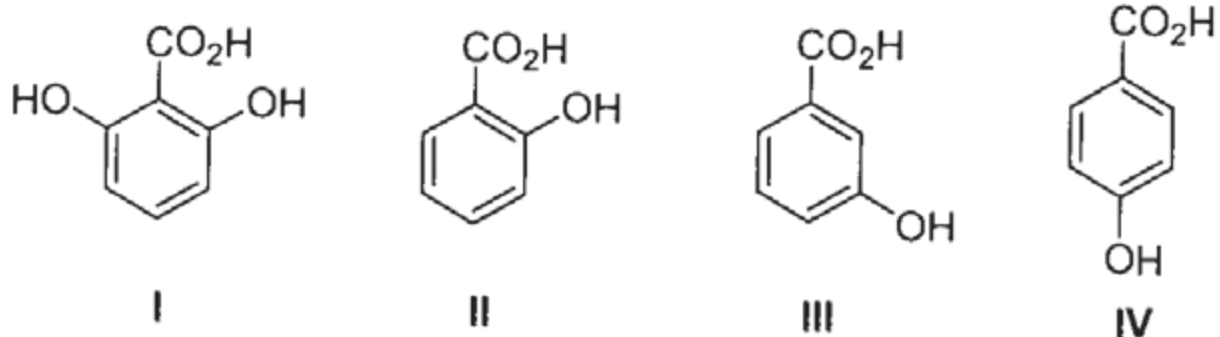
Options
A
Correct
B
C
D
Step-by-Step Solution
To determine the correct order of acidity for the given substituted benzoic acids, we analyze the stability of their respective conjugate bases (carboxylate anions) by considering inductive (), mesomeric/resonance (), and ortho/hydrogen-bonding effects:
-
Compound I (2,6-dihydroxybenzoic acid) and Compound II (2-hydroxybenzoic acid):
- Ortho Effect and Hydrogen Bonding: Hydroxyl () groups at the ortho position exert a strong ortho effect. Upon deprotonation, the carboxylate anion () is stabilized through intramolecular hydrogen bonding with the adjacent hydroxyl group(s).
- Comparison between I and II: Compound I possesses two ortho- groups, forming a highly stable, doubly intramolecularly hydrogen-bonded conjugate base. Compound II has only one ortho- group. Thus, Compound I is significantly more acidic than Compound II:
-
Compound III (3-hydroxybenzoic acid) and Compound IV (4-hydroxybenzoic acid):
- Meta Position (Compound III): At the meta position, the electron-donating mesomeric effect () of the group cannot operate on the carboxylate group. Only the electron-withdrawing inductive effect () acts, which stabilizes the conjugate base and increases acidity relative to phenol-substituted systems.
- Para Position (Compound IV): At the para position, the electron-donating resonance effect () of the group operates strongly and outweighs its electron-withdrawing inductive effect (). This increases the electron density on the carboxylic group, destabilizing the carboxylate anion and decreasing its acidity.
- Thus, Compound III is more acidic than Compound IV:
-
Overall Acidic Strength Comparison:
- Due to the dominant ortho effect and strong hydrogen bonding stabilization in conjugate bases, the ortho-substituted compounds (I and II) are far more acidic than the meta (III) and para (IV) substituted compounds.
Combining these findings gives the overall decreasing order of acidity:
This corresponds to Option (A).