Major Product Determination in Hydrobromination of Conjugated Diene
Determine the major organic product obtained in the following transformation:

Options
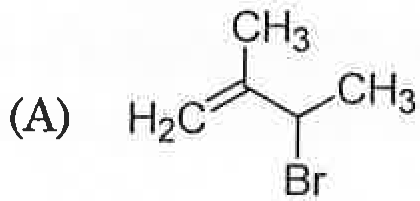
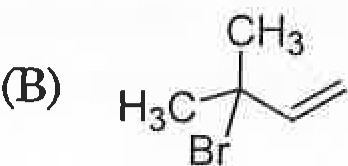
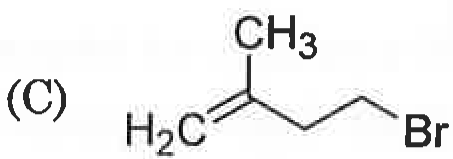
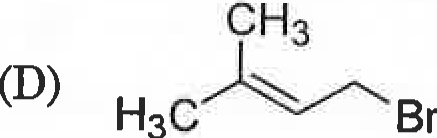
Topics & Concepts
Step-by-Step Solution
To determine the major product of the electrophilic addition of of to 2-methylbuta-1,3-diene (isoprene), we analyze the reaction mechanism step-by-step:
Step 1: Protonation (Electrophilic Attack of )
The starting diene, 2-methylbuta-1,3-diene, has two distinct double bonds:
Protonation occurs to yield the most stable allylic carbocation intermediate:
- Attack at : Gives a allylic carbocation:
- Attack at : Gives a allylic carbocation:
Since a tertiary allylic carbocation is significantly more stable than a secondary allylic carbocation, protonation preferentially takes place at . This generates the resonance-stabilized allylic intermediate:
Step 2: Nucleophilic Attack of
The bromide ion () can attack at two possible positions of the delocalized carbocation:
-
1,2-Addition (Kinetic Product): Attack of at forms 3-bromo-3-methylbut-1-ene: This product forms faster at lower temperatures due to lower activation energy (kinetic control), but it contains a mono-substituted alkene.
-
1,4-Addition (Thermodynamic Product): Attack of at forms 1-bromo-3-methylbut-2-ene: This product contains a tri-substituted, more highly substituted (and hence significantly more stable) double bond.
Step 3: Product Stability and Conclusion
Under standard reaction conditions, the reaction is thermodynamically controlled. The thermodynamically most stable alkene (1,4-addition product) predominates as the major product because it features a tri-substituted double bond rather than a mono-substituted double bond.
Thus, the major product is .
Correct Option: (D)