Magnitude of Force Across Diametrical Vertical Section of Water Column
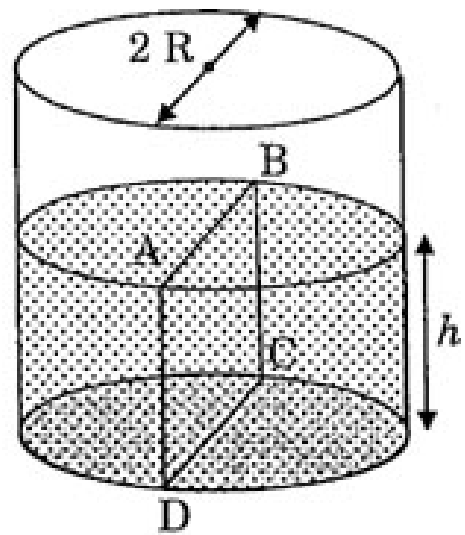
Water is filled up to a height in a beaker of radius as shown in the figure. The density of water is , the surface tension of water is and the atmospheric pressure is . Consider a vertical section ABCD of the water column through a diameter of the beaker. The force on water on one side of this section by water on the other side of this section has magnitude
Options
Topics & Concepts
Step-by-Step Solution
To find the magnitude of the force exerted on the water on one side of the vertical section by the water on the other side, we analyze the two interactions acting across the vertical plane :
- Force due to Hydrostatic Pressure:
The vertical section is a rectangle of width equal to the diameter of the beaker, , and height .
The absolute pressure at a depth below the free surface of the water is given by:
The force exerted on an infinitesimal horizontal strip of height and length is:
Integrating from the surface () to the bottom of the beaker ():
This pressure force is compressive and acts perpendicularly outward from the section, pushing the water on this side away.
- Force due to Surface Tension:
Along the line of the water's free surface at the top of the section (length ), surface tension exerts an attractive (tensile) force that acts to pull the two halves of the water surface together.
The magnitude of this force is:
Because surface tension acts as a tensile force, its direction is opposite to that of the compressive pressure force.
- Net Force:
The net force acting across the section from the other side of the water is the vector sum of these two collinear opposing forces:
Thus, the magnitude of the total force is:
Therefore, the correct option is B.