Electric Field Inside a Spherical Cavity of Charged Sphere
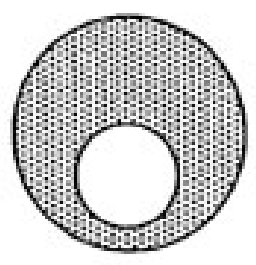
A spherical portion has been removed from a solid sphere having a charge distributed uniformly in its volume as shown in the figure. The electric field inside the emptied space is
Options
zero everywhere
non-zero and uniform
non-uniform
zero only at its center
Topics & Concepts
Step-by-Step Solution
To determine the electric field inside the spherical cavity, we can use the principle of superposition.
The given configuration of a uniformly charged solid sphere with a spherical cavity can be modeled as the superposition of:
- A complete solid sphere with a uniform volume charge density centered at point .
- A smaller sphere of the same size as the cavity with uniform volume charge density centered at the center of the cavity, .
By Gauss's Law, the electric field at an interior point of a uniformly charged solid sphere of charge density at a position vector from its center is:
Now, consider an arbitrary point inside the cavity:
- Let be the position vector of point relative to the center of the large sphere .
- Let be the position vector of point relative to the center of the cavity .
- Let be the displacement vector from the center of the large sphere to the center of the cavity , such that:
Using the superposition principle, the net electric field at point is the vector sum of the electric fields produced by the two spheres:
Substituting :
Since is a constant vector connecting the two centers and is non-zero (as the cavity is eccentric), the electric field inside the cavity is independent of the coordinates of point .
Therefore, the electric field inside the emptied space is non-zero and uniform.
Hence, the correct option is (B).