Magnitude of Final Capacitor Charge when Switch is Shifted to Position Q
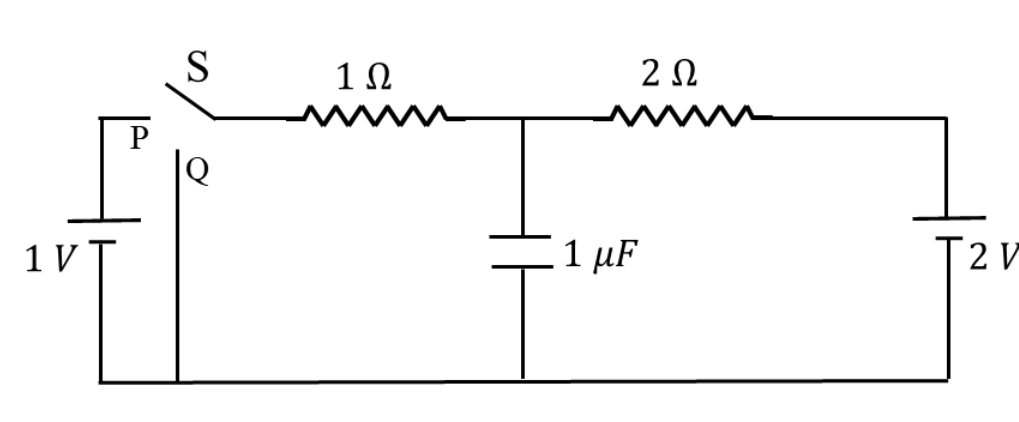
In the circuit diagram shown below, switch is maintained at position for a sufficiently long time such that the charge stored on the capacitor is . Switch is then flipped to position . After a long time, the charge on the capacitor becomes .
Determine the magnitude of .
Topics & Concepts
Step-by-Step Solution
To find the magnitude of the final charge on the capacitor, we analyze the circuit in its steady state after the switch is moved to position .
1. Circuit Description and Reference Potentials
Let the bottom wire of the circuit be chosen as the reference node with zero potential:
-
Switch at position : Position is directly connected to the bottom reference wire, so the potential at terminal is:
-
Far-right branch: The positive terminal of the battery is at a potential of relative to the bottom wire.
-
Capacitor branch: A capacitor is connected between the central node (let's call it node ) and the bottom reference wire ().
2. Steady-State Analysis for Switch at Position
In a DC circuit, after a sufficiently long time (steady state), the capacitor behaves as an open circuit (i.e., no current flows through the capacitor branch).
Therefore, current flows only through the outer loop containing the resistor, node , the resistor, and the battery.
Applying Kirchhoff's Current Law (KCL) at node :
Substitute :
3. Calculation of Charge
The charge stored on the capacitor in this steady state is given by:
Thus, the magnitude of is (or ).