Determine Radius of Zero Potential Circle
Comprehension Passage
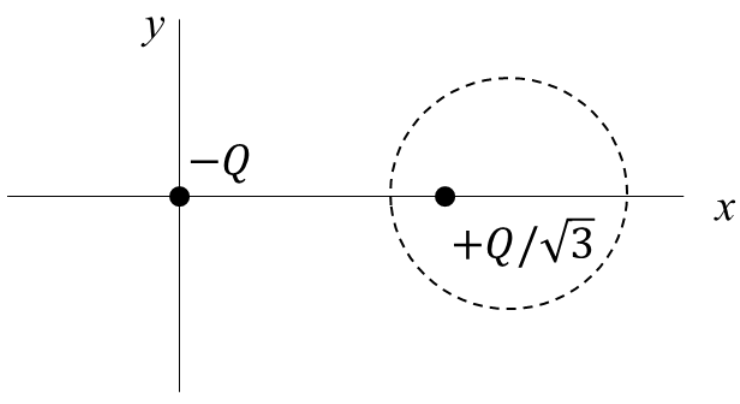
Consider two point charges and positioned in the -plane at the origin and at the point , respectively, as illustrated in the figure. This configuration creates an equipotential circle of radius with potential in the -plane, centered at . All spatial coordinates are specified in meters.
Find the value of the radius in meters.
Official Numerical Answer1.73
Topics & Concepts
Step-by-Step Solution
To find the radius of the zero potential circle, we set the total electric potential equal to zero for a general point in the -plane:
Equating the potential contributions gives:
Squaring both sides and simplifying the equation yields:
Dividing by and completing the square for :
This represents a circle centered at with radius .