Magnetic Response of Substances in External Magnetic Field Balance
In a given experimental setup, grams of a substance (which can be a gas, liquid, or solid) is loaded onto a balance container, as depicted in figure . Upon applying a magnetic field, the pan holding either shifts upwards (figure ) or downwards (figure ), determined by the magnetic nature of compound . Select the correct statement(s).
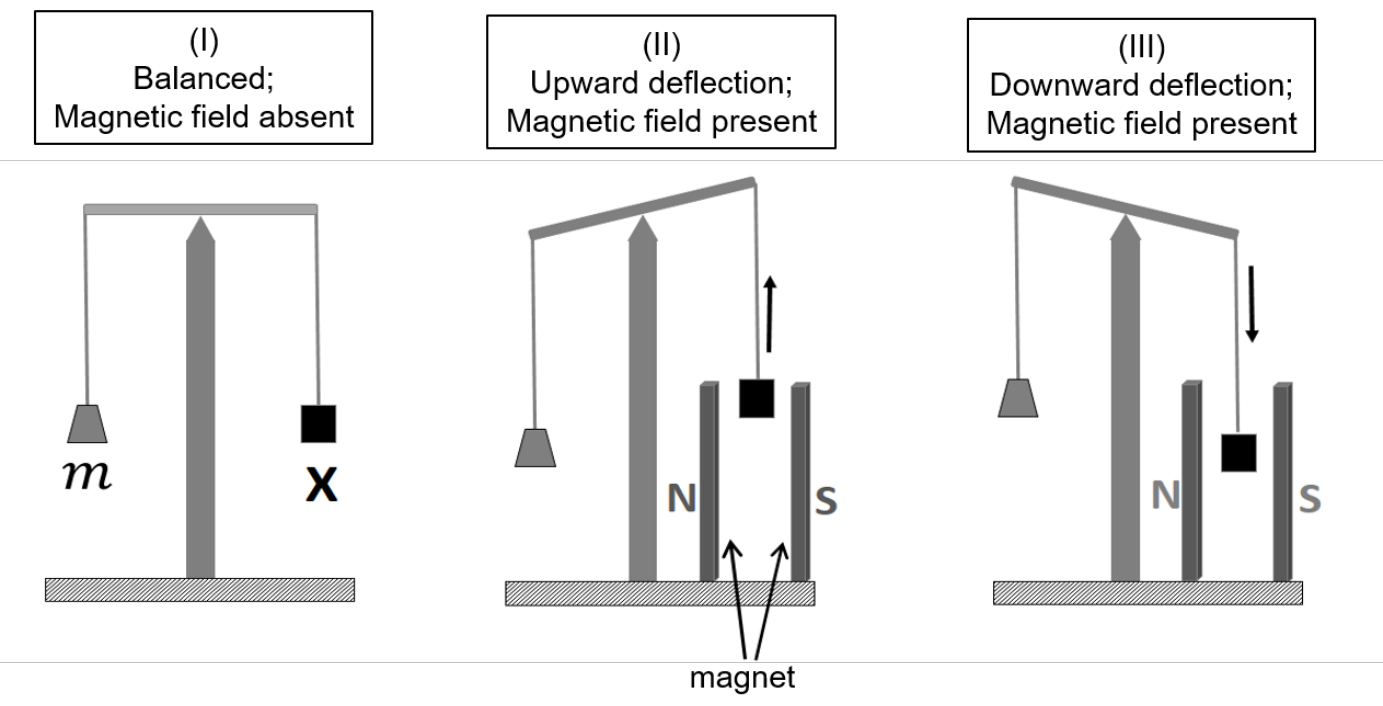
Options
If is , deflection of the pan is upwards.
If is , deflection of the pan is upwards.
If is , deflection of the pan is downwards.
If is , deflection of the pan is downwards.
Step-by-Step Solution
To determine the behavior of substance in the presence of an external magnetic field using Gouy's balance method:
-
Diamagnetic Substances: Substances with no unpaired electrons are weakly repelled by a magnetic field. Since the pole pieces of the magnet are located beneath/around the sample pan , a repulsive magnetic force acts upwards, pushing the sample pan away from the magnetic field. Hence, for a diamagnetic substance, an upward deflection (Figure ) is observed.
-
Paramagnetic Substances: Substances with unpaired electrons are attracted into a magnetic field. The attractive magnetic force pulls the sample pan downwards into the region of maximum magnetic field strength. Hence, for a paramagnetic substance, a downward deflection (Figure ) is observed.
Analysis of the Options:
-
Option (A):
- Water contains only paired electrons in all its chemical bonds and lone pairs.
- Therefore, is diamagnetic.
- Being diamagnetic, it experiences a repulsive force and causes an upward deflection of the pan.
- Statement (A) is CORRECT.
-
Option (B):
- In the complex ion , iron is in the oxidation state (, configuration).
- is a strong field ligand, causing maximum pairing of -electrons:
- Since the number of unpaired electrons , the compound is diamagnetic.
- Being diamagnetic, it experiences an upward deflection of the pan.
- Statement (B) is CORRECT.
-
Option (C):
- According to Molecular Orbital Theory (MOT), the molecular orbital electronic configuration of is:
- It contains unpaired electrons in the degenerate antibonding molecular orbitals ().
- Therefore, is paramagnetic.
- Being paramagnetic, it is pulled into the magnetic field, causing a downward deflection of the pan.
- Statement (C) is CORRECT.
-
Option (D):
- Benzene () has a closed-shell aromatic electronic structure with all electrons fully paired.
- Therefore, is diamagnetic.
- Being diamagnetic, it should cause an upward deflection, not a downward deflection.
- Statement (D) is INCORRECT.
Conclusion:
The correct statements are A, B, and C.