JEE Challenger
More from Electromagnetic Induction

Magnetic Moment of Wire Loop Inside Long Current Tube

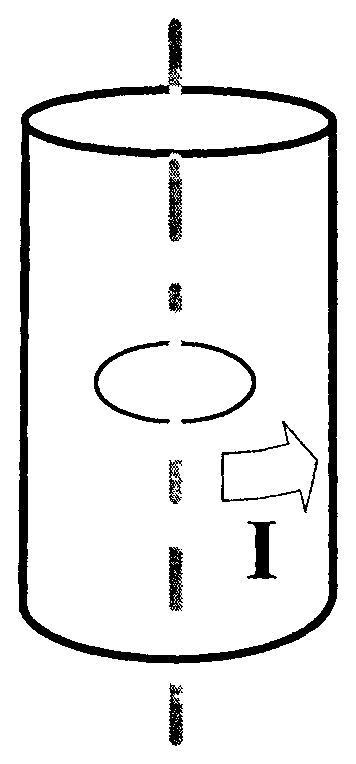
A long circular tube of length 10 m10\text{ m} and radius 0.3 m0.3\text{ m} carries a current II along its curved surface as shown. A wire-loop of resistance 0.005 ohm0.005\text{ ohm} and of radius 0.1 m0.1\text{ m} is placed inside the tube with its axis coinciding with the axis of the tube. The current varies as I=I0cos⁡(300t)I = I_0 \cos (300 t) where I0I_0 is constant. If the magnetic moment of the loop is Nμ0I0sin⁡(300t)N \mu_0 I_0 \sin (300 t), then 'N' is

Diagram 0

Official Numerical Answer6

Step-by-Step Solution

To find the value of NN, we analyze the electromagnetic induction in the wire-loop step-by-step.

1. Magnetic Field Inside the Long Tube

The tube acts as a long solenoid carrying a surface current II around its circumference. The magnetic field B(t)B(t) inside such a uniform tube along its axis is given by:
B(t)=μ0(I(t)L)B(t) = \mu_0 \left(\frac{I(t)}{L}\right)

Given that I(t)=I0cos⁡(300t)I(t) = I_0 \cos(300t) and length L=10 mL = 10\text{ m}:
B(t)=μ0I0Lcos⁡(300t)B(t) = \frac{\mu_0 I_0}{L} \cos(300t)

2. Magnetic Flux Linked with the Wire-Loop

The loop has a radius r=0.1 mr = 0.1\text{ m} and its plane is perpendicular to the axis of the tube. The magnetic flux Φ(t)\Phi(t) through the area of the loop A=πr2A = \pi r^2 is:
Φ(t)=B(t)⋅A=(μ0I0Lcos⁡(300t))(πr2)=πr2μ0I0Lcos⁡(300t)\Phi(t) = B(t) \cdot A = \left(\frac{\mu_0 I_0}{L} \cos(300t)\right) (\pi r^2) = \frac{\pi r^2 \mu_0 I_0}{L} \cos(300t)

3. Induced EMF and Current in the Loop

By Faraday's Law of Electromagnetic Induction, the magnitude of the induced electromotive force (EMF) E(t)\mathcal{E}(t) in the loop is:
E(t)=∣−dΦ(t)dt∣=πr2μ0I0L⋅300sin⁡(300t)\mathcal{E}(t) = \left| -\frac{d\Phi(t)}{dt} \right| = \frac{\pi r^2 \mu_0 I_0}{L} \cdot 300 \sin(300t)

Using Ohm's law, the induced current i(t)i(t) flowing through the loop of resistance R=0.005 ΩR = 0.005\ \Omega is:
i(t)=E(t)R=300πr2μ0I0LRsin⁡(300t)i(t) = \frac{\mathcal{E}(t)}{R} = \frac{300 \pi r^2 \mu_0 I_0}{L R} \sin(300t)

4. Magnetic Moment of the Loop

The magnetic moment M(t)M(t) of the wire-loop is the product of the induced current i(t)i(t) and the area of the loop A=πr2A = \pi r^2:
M(t)=i(t)⋅(πr2)=(300πr2μ0I0LRsin⁡(300t))(πr2)=300π2r4LRμ0I0sin⁡(300t)M(t) = i(t) \cdot (\pi r^2) = \left( \frac{300 \pi r^2 \mu_0 I_0}{L R} \sin(300t) \right) (\pi r^2) = \frac{300 \pi^2 r^4}{L R} \mu_0 I_0 \sin(300t)

5. Calculation of NN

Comparing this with the given expression M(t)=Nμ0I0sin⁡(300t)M(t) = N \mu_0 I_0 \sin(300t), we obtain:
N=300π2r4LRN = \frac{300 \pi^2 r^4}{L R}

Substituting the given numerical values:

  • r=0.1 m  ⟹  r4=10−4 m4r = 0.1\text{ m} \implies r^4 = 10^{-4}\text{ m}^4
  • L=10 mL = 10\text{ m}
  • R=0.005 Ω=5×10⁻³ ΩR = 0.005\ \Omega = 5 \times 10^{-3}\ \Omega
  • Taking π2≈10\pi^2 \approx 10

N=300×10×10−410×(5×10−3)=0.30.05=6N = \frac{300 \times 10 \times 10^{-4}}{10 \times (5 \times 10^{-3})} = \frac{0.3}{0.05} = 6

Thus, the value of NN is 66.