JEE Challenger
More from Moving Charges and Magnetism

Magnetic Field at Origin Due to Current Carrying Wire Segments in XY Plane

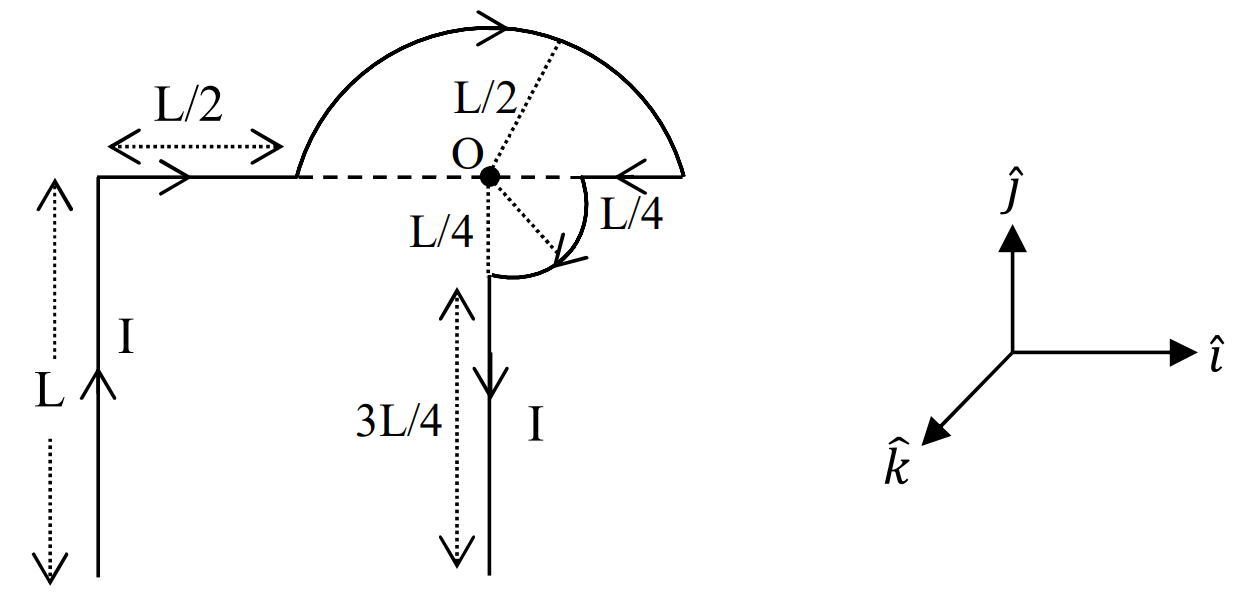
Select the option that correctly gives the net magnetic field B⃗\vec{B} at point O caused by current passing through the specified wire segments situated in the xyxy plane.

Question Diagram 1

Options

A

B⃗=−μ0IL(32+142π)k^\vec{B} = \frac{-\mu_0 I}{L}\left(\frac{3}{2} + \frac{1}{4\sqrt{2}\pi}\right)\hat{k}

B

B⃗=−μ0IL(32+122π)k^\vec{B} = -\frac{\mu_0 I}{L}\left(\frac{3}{2} + \frac{1}{2\sqrt{2}\pi}\right)\hat{k}

C

B⃗=−μ0IL(1+142π)k^\vec{B} = \frac{-\mu_0 I}{L}\left(1 + \frac{1}{4\sqrt{2}\pi}\right)\hat{k}

Correct
D

B⃗=−μ0IL(1+14π)k^\vec{B} = \frac{-\mu_0 I}{L}\left(1 + \frac{1}{4\pi}\right)\hat{k}

Step-by-Step Solution

To find the net magnetic field B⃗\vec{B} at the origin OO due to the current-carrying wire configuration in the xyxy-plane, we evaluate the contribution of each individual wire segment using the Biot-Savart law.


1. Straight Wire Segments Passing Through or Directed Towards Origin OO

For any straight wire segment lying along a line that passes directly through the origin OO, the current element vector dl⃗\mathrm{d}\vec{l} is parallel or antiparallel to the position vector r⃗\vec{r} relative to OO. Therefore: dl⃗×r⃗=0  ⟹  B⃗radial=0\mathrm{d}\vec{l} \times \vec{r} = 0 \implies \vec{B}_{\text{radial}} = 0


2. Upper Semi-Circular Arc

  • Radius: R1=L2R_1 = \frac{L}{2}
  • Angle subtended at origin: θ1=π rad\theta_1 = \pi\text{ rad} (semi-circle)
  • Direction of current: Clockwise in the upper half-plane (y>0y > 0).

By the right-hand rule, a clockwise current produces a magnetic field directed into the page (−k^-\hat{k}).

The magnitude of the magnetic field due to this semi-circular arc is: Barc1=μ0I4πR1θ1=μ0I4π(L2)(π)=μ0I2LB_{\text{arc1}} = \frac{\mu_0 I}{4\pi R_1} \theta_1 = \frac{\mu_0 I}{4\pi \left(\frac{L}{2}\right)} (\pi) = \frac{\mu_0 I}{2L}

Thus, the magnetic field vector is: B⃗arc1=−μ0I2Lk^\vec{B}_{\text{arc1}} = -\frac{\mu_0 I}{2L} \hat{k}


3. Lower Quarter-Circular Arc

  • Radius: R2=L4R_2 = \frac{L}{4}
  • Angle subtended at origin: θ2=π2 rad\theta_2 = \frac{\pi}{2}\text{ rad} (quarter-circle)
  • Direction of current: Clockwise in the fourth quadrant.

Using the right-hand rule, the magnetic field is also directed into the page (−k^-\hat{k}).

The magnitude of the magnetic field due to this quarter-circular arc is: Barc2=μ0I4πR2θ2=μ0I4π(L4)(π2)=μ0I2LB_{\text{arc2}} = \frac{\mu_0 I}{4\pi R_2} \theta_2 = \frac{\mu_0 I}{4\pi \left(\frac{L}{4}\right)} \left(\frac{\pi}{2}\right) = \frac{\mu_0 I}{2L}

Thus, the magnetic field vector is: B⃗arc2=−μ0I2Lk^\vec{B}_{\text{arc2}} = -\frac{\mu_0 I}{2L} \hat{k}


4. Vertical Straight Wire Segment

For the finite straight vertical wire segment, the magnetic field magnitude at a perpendicular distance dd subtending angles θ1\theta_1 and θ2\theta_2 at the ends is given by: Bstraight=μ0I4πd(sin⁡θ1+sin⁡θ2)B_{\text{straight}} = \frac{\mu_0 I}{4\pi d} (\sin\theta_1 + \sin\theta_2)

With perpendicular distance d=Ld = L, θ1=0∘\theta_1 = 0^\circ, and θ2=45∘\theta_2 = 45^\circ (sin⁡45∘=12\sin 45^\circ = \frac{1}{\sqrt{2}}): Bstraight=μ0I4πL(0+12)=μ0I42πLB_{\text{straight}} = \frac{\mu_0 I}{4\pi L} \left(0 + \frac{1}{\sqrt{2}}\right) = \frac{\mu_0 I}{4\sqrt{2}\pi L}

By the right-hand rule, the magnetic field due to this straight segment is directed along −k^-\hat{k}: B⃗straight=−μ0I42πLk^\vec{B}_{\text{straight}} = -\frac{\mu_0 I}{4\sqrt{2}\pi L} \hat{k}


5. Net Magnetic Field at Origin OO

Summing the individual contributions from all segments: B⃗net=B⃗arc1+B⃗arc2+B⃗straight\vec{B}_{\text{net}} = \vec{B}_{\text{arc1}} + \vec{B}_{\text{arc2}} + \vec{B}_{\text{straight}}

B⃗net=−(μ0I2L+μ0I2L+μ0I42πL)k^\vec{B}_{\text{net}} = -\left( \frac{\mu_0 I}{2L} + \frac{\mu_0 I}{2L} + \frac{\mu_0 I}{4\sqrt{2}\pi L} \right) \hat{k}

B⃗net=−μ0IL(1+142π)k^\vec{B}_{\text{net}} = -\frac{\mu_0 I}{L} \left( 1 + \frac{1}{4\sqrt{2}\pi} \right) \hat{k}


Conclusion

The correct option is C.

Magnetic Field at Origin Due to Current Carrying Wire Segments in XY Plane | Physics PYQ Solution - JEE Challenger