Kinetic Energy of Block Pulled Along Elliptical Rail
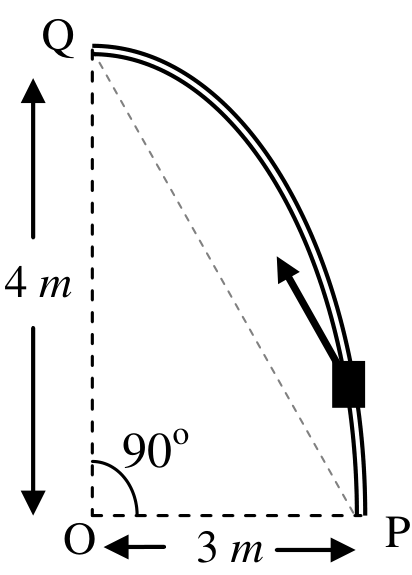
An elliptically shaped rail is fixed in a vertical plane, where and . A block with a mass of is pulled along this rail starting from to by applying a constant magnitude force of that always remains parallel to the straight line (as shown in the given figure). Assuming frictional resistance is negligible, the kinetic energy of the block upon reaching is expressed as . Determine the integer value of . (Take gravitational acceleration )
Topics & Concepts
Step-by-Step Solution
To find the kinetic energy of the block upon reaching , we can apply the Work-Energy Theorem, which states that the net work done on an object is equal to the change in its kinetic energy:
Given that the block starts from rest at point , its initial kinetic energy is . Therefore, the kinetic energy at is:
where is the work done by the applied pulling force and is the work done by the gravitational force.
Step 1: Work Done by the Applied Force ()
Let the origin be at . Then, the coordinates of points and are:
The displacement vector from to is:
The magnitude of the displacement along the straight line is:
Since the applied force has a constant magnitude of and remains constantly parallel to the line , is a constant vector pointing in the direction of . The work done by a constant force depends only on the total displacement vector, regardless of the path taken along the elliptical rail:
Step 2: Work Done by Gravity ()
The force of gravity acts vertically downwards (). The change in vertical height as the block moves from () to () is .
Step 3: Kinetic Energy at
Summing the work done by both forces:
We are given that :