Collision Time of Balls Inside Accelerating Rocket
A rocket travels in a gravity-free environment with a constant acceleration of along the direction (refer to diagram). The inner chamber of the rocket measures in length. A ball is projected from the left boundary of the chamber towards the direction at a speed of relative to the rocket. Simultaneously, another ball is projected from the right boundary towards the direction with a speed of relative to the rocket. Calculate the time in seconds at which the two balls collide with each other.
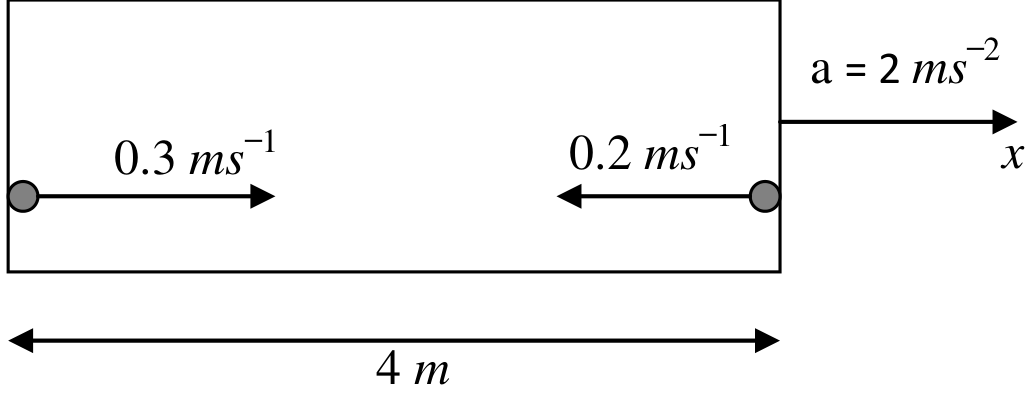
Topics & Concepts
Step-by-Step Solution
To find the time at which the two balls collide inside the accelerating rocket, we can analyze their motion either in an inertial frame of reference (ground frame) or in the non-inertial frame of reference attached to the rocket.
Method 1: Analysis in the Reference Frame of the Rocket
Let the rocket frame be our frame of reference. Since the rocket travels with an acceleration in the direction, a fictitious (pseudo) acceleration of acts on both balls in the direction.
-
Acceleration of Ball 1 (projected from the left boundary): Initial velocity relative to rocket:
-
Acceleration of Ball 2 (projected from the right boundary): Initial velocity relative to rocket:
-
Relative Motion Between the Two Balls:
- Relative initial velocity of Ball 1 with respect to Ball 2:
- Relative acceleration of Ball 1 with respect to Ball 2:
- Initial distance between the two balls:
Using the second equation of motion for relative motion:
Substituting the known values:
Method 2: Alternate Interpretation (Neglecting Initial Relative Speeds)
If the initial relative speeds of projection ( and ) are neglected in comparison to the acceleration of the rocket frame, the relative distance is covered entirely due to the rocket's acceleration :
Final Answer:
The time at which the two balls collide is (or considering direct relative velocity).