Irreversible Expansion of Ideal Gas into Vacuum in Insulated Vessel
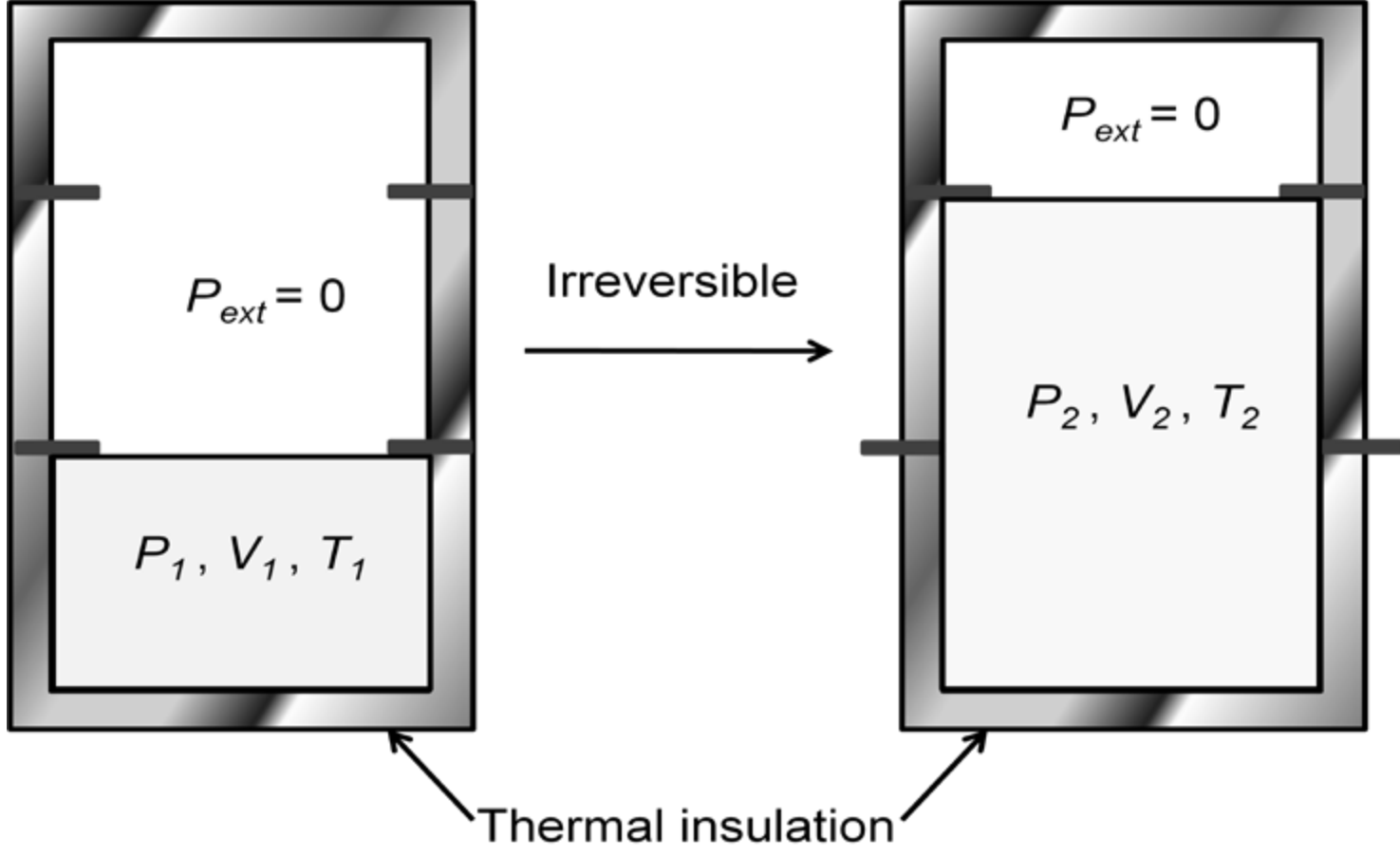
Suppose an ideal gas is kept within a thermally insulated container at an initial internal pressure , volume , and absolute temperature . It undergoes an irreversible expansion against zero external pressure, as illustrated in the diagram. Let the final internal pressure, volume, and absolute temperature be , , and , respectively. Which of the following conditions hold true for this expansion?
Options
Topics & Concepts
Step-by-Step Solution
To determine the correct conditions for the given expansion, we analyze the thermodynamics of the process step-by-step:
-
Evaluation of Heat Exchange (): The container is thermally insulated from the surroundings, which means that no heat can enter or leave the system. Therefore, the process is adiabatic: Hence, Option (A) is correct.
-
Evaluation of Work Done () and Internal Energy Change (): The gas undergoes free expansion into a vacuum, meaning it expands against zero external pressure (). The work done during the expansion is given by: According to the First Law of Thermodynamics: Substituting and :
-
Evaluation of Temperature (): For an ideal gas, the internal energy is solely a function of temperature (). Therefore: Since , this implies: Hence, Option (B) is correct.
-
Evaluation of the Relationship: Using the ideal gas equation of state for the initial and final states: Since , it follows directly that: Hence, Option (C) is correct.
-
Evaluation of the Adiabatic Reversible Equation (): The relation is valid only for a reversible adiabatic process of an ideal gas. For the given irreversible free expansion: Since the gas expands, , and for any ideal gas , we have: Thus, . Hence, Option (D) is incorrect.
Therefore, the correct options are A, B, and C.