Identify Substituents in Newman Projection of 2,2-Dimethylbutane
In the Newman projection for 2,2-dimethylbutane
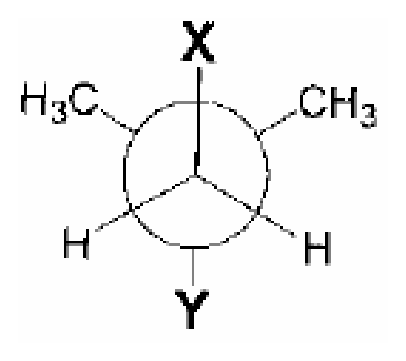
and can respectively be
Options
and
and
and
and
Step-by-Step Solution
To determine the substituents and in the given Newman projection of 2,2-dimethylbutane, we analyze the molecular structure and the projection diagram.
1. Molecular Structure of 2,2-Dimethylbutane
The IUPAC structure and numbering of 2,2-dimethylbutane is:
2. Analysis of the Given Newman Projection Diagram
From the visual representation:
- Front Carbon (represented by the central vertex where three bonds meet):
It has two hydrogen atoms () and one substituent attached to it. Thus, its substituents are:
- Back Carbon (represented by the circle):
It has two methyl groups () and one substituent attached to it. Thus, its substituents are:
Since the back carbon has two methyl groups attached to it, it must correspond to of 2,2-dimethylbutane. The front carbon, being directly bonded to , can be either or .
3. Case Analysis
Case 1: Viewing along the bond (Front Carbon = , Back Carbon = )
-
Front Carbon (): Being a terminal methyl group, is bonded to three hydrogen atoms ().
Comparing with , we get:
-
Back Carbon (): Apart from the bond, is bonded to two methyl groups () and an ethyl group ().
Comparing with , we get:
Thus, and , which corresponds to Option B.
Case 2: Viewing along the bond (Front Carbon = , Back Carbon = )
-
Front Carbon (): is bonded to two hydrogen atoms and one methyl group ().
Comparing with , we get:
-
Back Carbon (): Apart from the bond, is bonded to three methyl groups (two attached to and one from ).
Comparing with , we get:
Thus, and , which corresponds to Option D.
Conclusion
Therefore, and can respectively be and or and .
Correct Options: B and D