Identify Intermediates in Bromination of Phenol Derivative
In the reaction
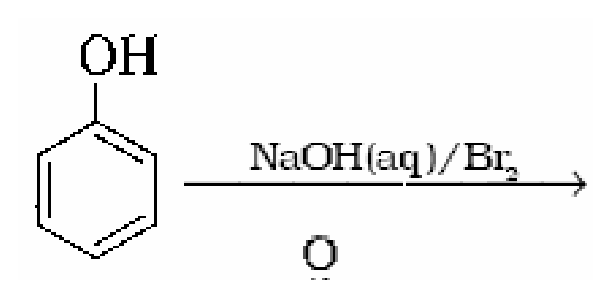
the intermediate(s) is(are)
Options
Step-by-Step Solution
In the presence of an aqueous solution of sodium hydroxide (), phenol () is deprotonated to yield the phenoxide ion ():
The phenoxide ion () is an extremely strong activating group due to its powerful resonance electron-donating effect ( effect), which dramatically increases the electron density at the ortho and para positions relative to the meta position.
When bromine () is added to this solution, rapid electrophilic aromatic substitution (EAS) takes place in a stepwise manner:
-
First Substitution (Formation of C):
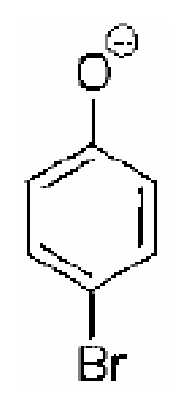
The electrophilic attack of occurs primarily at the para-position of the phenoxide ion (due to lower steric hindrance relative to the ortho-positions). Deprotonation restores aromaticity, yielding the 4-bromophenoxide ion (Option C). -
Second Substitution (Formation of A):
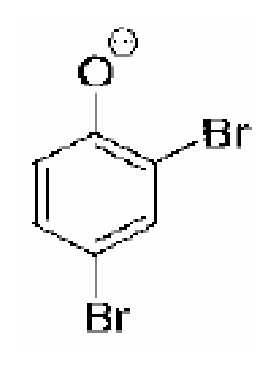
The 4-bromophenoxide ion remains highly activated by the phenoxide group. Subsequent electrophilic attack by a second equivalent of occurs at one of the available ortho-positions to give the 2,4-dibromophenoxide ion (Option A). -
Final Substitution:
A third bromination step at the remaining vacant ortho-position yields 2,4,6-tribromophenoxide, which precipitates as 2,4,6-tribromophenol upon neutralization.
Analysis of Options:
- Option A: Represents the 2,4-dibromophenoxide intermediate, which is formed after two successive brominations at the ortho and para positions.
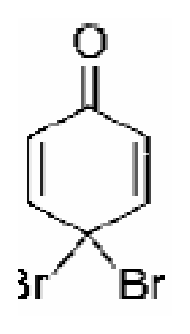
- Option B: Represents a non-aromatic 4,4-dibromocyclohexa-2,5-dienone species, which is not an intermediate in the standard electrophilic aromatic substitution pathway to 2,4,6-tribromophenol.
- Option C: Represents the 4-bromophenoxide intermediate, formed in the initial bromination step.
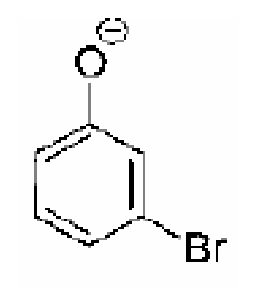
- Option D: Represents a 3-bromophenoxide (meta-substituted) ion, which does not form because the phenoxide group () is strongly ortho/para-directing.
Thus, the intermediates formed in the reaction are A and C.